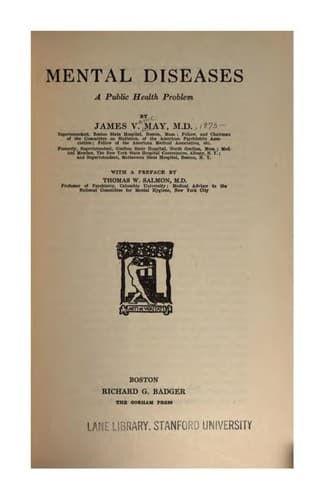
Mental diseases: a public health problemMay, James Vance
Science
Mental diseases: a public health problem
May, James Vance
Mental health services; Psychology, Pathological
incipient mental diseases which could be detected by even a superficial
psychiatric examination.
Serious consideration should be given to the advisability of subjecting
to a careful mental examination such persons, at least, as are to be
charged with an entire responsibility for the lives of others. It is
a question as to whether this procedure is not indicated in the case
of other important public trusts where the interest of the community
should be safeguarded.
The correlation of psychiatry and psychology as scientific aids to
industrial efficiency promises to open up entirely new and important
sociological fields of research which have only recently attracted
attention.[7] This is a subject of far reaching importance. The extent
to which the industrial classes of the country are affected is shown
by the following analysis of the occupations represented by 104,013
admissions to New York state hospitals: 1. Professional—(clergy,
military and naval officers, physicians, lawyers, architects, artists,
authors, civil engineers, surveyors, etc.) 1,926 or 1.8 per cent;
2. Commercial—(bankers, merchants, accountants, clerks, salesmen,
shopkeepers, shopmen, stenographers, typewriters, etc.) 7,572 or
7.2 per cent; 3. Agricultural—(farmers, gardeners, etc.) 5,942 or
5.7 per cent; 4. Mechanics—at Outdoor Vocations—(blacksmiths,
carpenters, enginefitters, sawyers, painters, etc.) 8,564 or 8.2 per
cent; 5. Mechanics at Sedentary Vocations—(bootmakers, bookbinders,
compositors, tailors, weavers, bakers, etc.) 7,501 or 7.2 per cent;
6. Domestic Service—(waiters, cooks, servants, etc.) 21,037 or 20.2
per cent; 7. Educational and Higher Domestic Duties—(governesses,
teachers, students, housekeepers, nurses, etc.) 21,861 or 21 per cent;
8. Commercial—(shopkeepers, saleswomen, stenographers,
typewriters, etc.) 1,140 or 1.09 per cent; 9. Employed at Sedentary
Occupations—(tailoresses, seamstresses, bookbinders, factory workers,
etc.) 4,310 or 4.1 per cent; 10. Miners, Seamen, etc., 581 or .56 per
cent; 11. Prostitutes, 81 or .08 per cent; 12. Laborers, 12,962 or 12.4
per cent; No occupation, 7,820 or 7.5 per cent; Unascertained, 2,715 or
2.6 per cent.[8] This certainly indicates an enormous economic loss to
the community.
The intimate relation between mental diseases, alcoholism, ignorance,
poverty, prostitution, criminality, mental defects, etc., suggests
social and economic problems of far reaching importance, each one
meriting separate and special consideration. These problems, while
perhaps essentially sociological in origin, have at the same time an
important educational bearing, invade the realm of psychology and
depend largely, if not entirely, upon psychiatry for a solution.
CHAPTER II
THE EVOLUTION OF THE MODERN HOSPITAL
Public-domain text, read in full here on John Shaqi.
Reviews
Reviews
No reviews yet
Be the first to share your thoughts on this work.
Join the Discussion
Join the discussion
Sign in to leave a comment or review.
Sign InorCreate an account