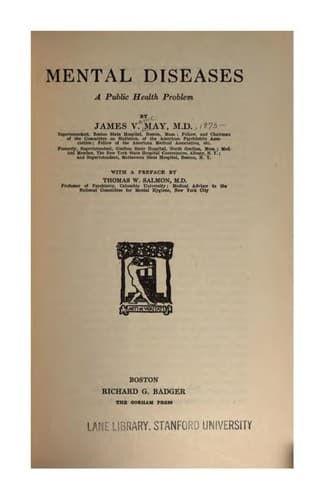
Mental diseases: a public health problemMay, James Vance
Science
Mental diseases: a public health problem
May, James Vance
Mental health services; Psychology, Pathological
The medical treatment of mental diseases had its inception, in this
country, in the wards of the Philadelphia Hospital, established in
1732 and referred to officially for over a century as an almshouse. It
included an infirmary for the "sick and insane," although it apparently
had no distinct and separate hospital department for many years. "In
1742," to use the words of Dr. D. Hayes Agnew, "it was fulfilling a
varied routine of beneficent functions in affording shelter, support
and employment for the poor and indigent, a hospital for the sick,
and an asylum for the idiotic, the insane and the orphan. It was
dispensing its acts of mercy and blessing when Pennsylvania was yet
a province and her inhabitants the loyal subjects of Great Britain."
In 1772 it housed as many as three hundred and fifty persons. In 1769
the General Assembly passed an act authorizing the "Managers of the
Contributions for the Relief and Employment of the Poor," who had
charge of the almshouse, to issue bills of credit for the purpose of
relieving their indebtedness. This paper currency was issued in three
denominations—one shilling, two shillings and a half crown. The law
provided that counterfeiters or persons altering the denomination of
these bills should be "sentenced to the pillory, have both his or her
ears cut off and nailed to the pillory and be publicly whipped on his
or her back with thirty-nine lashes, well laid on, and, moreover,
every such offender shall forfeit the sum of one hundred pounds, to be
levied on his or her land, tenements, goods and chattels."[9] This
certainly must have discouraged counterfeiting. It was not until after
the institution was removed to the Hamilton estate in Blockley (now
a part of West Philadelphia) in 1834 that it came to be known as the
"Philadelphia Hospital and Almshouse," although there was no change
made in its organization or functions. In 1902, after one hundred
and seventy years of continuous existence, it was finally divided
officially for administrative purposes into The Philadelphia Home or
Hospital for the Indigent, The Philadelphia General Hospital and The
Philadelphia Hospital for the Insane. At that time the hospital was, as
it is today, the largest on the American continent. The institution,
which has admitted mental cases uninterruptedly since 1732, had over
seventeen hundred patients in the department for the insane. In 1917
this number had increased to nearly three thousand.
Public-domain text, read in full here on John Shaqi.
Reviews
Reviews
No reviews yet
Be the first to share your thoughts on this work.
Join the Discussion
Join the discussion
Sign in to leave a comment or review.
Sign InorCreate an account