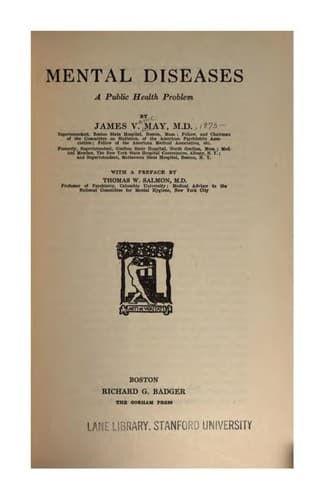
Mental diseases: a public health problemMay, James Vance
Science
Mental diseases: a public health problem
May, James Vance
Mental health services; Psychology, Pathological
Kraepelin[221] described acute and chronic alcoholism, pathological
intoxication, alcoholic jealousy, delirium tremens, Korsakow's
psychosis, alcoholic hallucinoses, paralysis and pseudo-paresis. In
acute intoxication Kraepelin finds an inhibition of apprehension,
mental grasp and the elaboration of outer impressions with a
stimulation of the release of volitional impulses. A clouding of
consciousness develops, associated with emotional excitement and a
weakness of will power. Perception and mental reactions are delayed
and their accuracy decreased on mental tests. The discrimination
between louder sounds is uncertain, although the sensitiveness to
lighter sound impressions is increased as in the ether narcosis.
Busch found a limitation of the field of vision. The preservation of
memory impressions is imperfect. A solution of mathematical problems
shows a lowered mental capacity for work. The association of ideas
and composition of sentences is delayed. There is a tendency to
new word formation, phrasing and rhyming, with a certain amount of
distractibility. Goal ideas are often missed, and consistent, orderly
thought is not possible. Expression is rapid and impulsive, and is
often characterized by a loud tone of voice.
After larger amounts of alcohol psychomotor activities are interfered
with as shown by the writing, and ataxia appears. The reflexes show an
increased muscular tension. Physical strength is markedly lowered,
although it may be increased for a very short time. Alcohol even in
small amounts interferes with productive mental processes. Ideas lose
in clearness and sharpness, fatigue occurs earlier and efficiency and
judgment are impaired. Still larger amounts retard apprehension and
comprehension and the intoxicated person no longer knows what is said
to him. All ability to control his conduct is lost. There is a tendency
to repetition in speech, rhyming and jargon. Capacity for mental work
is finally entirely gone and memory becomes confused. Psychomotor
stimulation and excitement appear early, terminating finally in
weakness. Emotional trends, at first happy and cheerful, are usually
irritable, later with outbursts of anger. Sexual excitement often
appears. Various physical disturbances have been described.
Public-domain text, read in full here on John Shaqi.
Reviews
Reviews
No reviews yet
Be the first to share your thoughts on this work.
Elsewhere in the archive
Join the Discussion
Join the discussion
Sign in to leave a comment or review.
Sign InorCreate an account