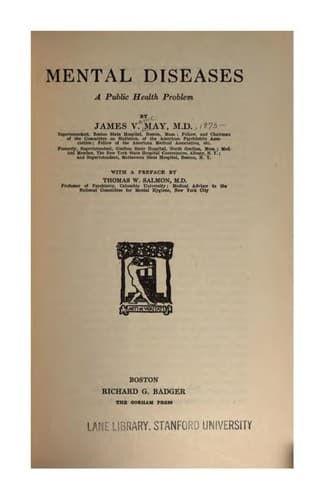
Mental diseases: a public health problemMay, James Vance
Science
Mental diseases: a public health problem
May, James Vance
Mental health services; Psychology, Pathological
In the pathological or complicated intoxications as described
by Kraepelin, unusual emotional disturbances such as violent
excitements occur. Anger or anxiety may develop with a clouding of
the consciousness, and lead to uncontrollable rages with impulses to
assault and kill. The most marked excitements occur in epileptics.
The outburst is usually sudden in these cases and is followed by the
most senseless and unjustifiable acts. Occasionally suicide is the
result. In hysterical and psychopathic individuals alcohol may cause
serious emotional disturbances, with clouding of consciousness or even
delusion formation. Chronic drinkers are very likely to have abnormal
symptoms at times. They often show a marked irritability followed
by a pathetic and tearful mood. Abusive treatment of members of the
family, jealousy, threats and violence are not uncommon. Delirious or
anxious states with persecutory ideas and hallucinations are sometimes
observed. These may exist only during intoxication. Alcohol often
produces extreme excitements in cases of manic-depressive insanity,
general paresis and dementia praecox. Pathological changes of various
kinds have been reported. In acute alcoholism Nissl found a destruction
of cortical cells in some cases and a disappearance of the stainable
lumps in others. The nuclei of the neurones were shrunken and sometimes
displaced.
Various tests have demonstrated the limited mental capacity of the
chronic alcoholic. Will power is greatly reduced and fatigability
increased. Memory and attention are affected and falsification of
the past may occur. The patient learns nothing new and forgets the
important things. All productive efficiency is gone and interest is
lost. Weakness of judgment and loss of memory capacity lead to delusion
formation. These often take the form of ideas of jealousy. Delusions
of persecution, poisoning or grandeur may appear from time to time.
Frequently there are genuine hallucinations. Some cases terminate
finally in mental enfeeblement. Emotional changes are common in the
chronic drinkers. The alcoholic humor is characteristic. The capacity
for taking things seriously has been lost and there is a tendency to
undue levity, often with a marked feeling of self-satisfaction. Some
individuals, however, become moody, irritable or dull. Occasionally
anxious states appear, frequently with suicidal attempts. One of the
common symptoms of this condition is an extraordinary irritability
after drinking. This leads to quarrels, assaults and violence.
Consideration for others is completely lost. These attacks are often
followed by remorse. A prominent and significant feature of the
disease is the marked moral deterioration. All affection for family
and children may be lost. Selfishness is pronounced and the patient
spends all of his money for drink. Sexual excitement is sometimes
an important symptom. With all of this there is a constant craving
for alcohol. The patients have no insight into their condition and
Public-domain text, read in full here on John Shaqi.
Reviews
Reviews
No reviews yet
Be the first to share your thoughts on this work.
Elsewhere in the archive
Join the Discussion
Join the discussion
Sign in to leave a comment or review.
Sign InorCreate an account