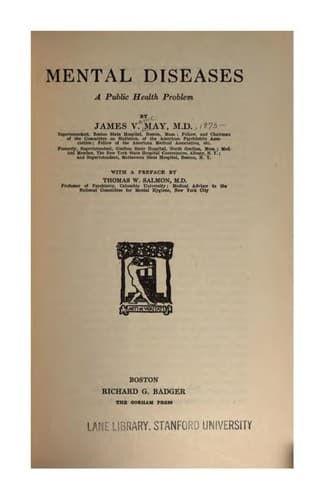
Mental diseases: a public health problemMay, James Vance
Science
Mental diseases: a public health problem
May, James Vance
Mental health services; Psychology, Pathological
One-fifth of Kraepelin's cases became chronic. Bonhöffer described a
paranoid type of long duration. The hallucinoses appear usually earlier
in life than Korsakow's psychosis but later than delirium tremens. In
Kraepelin's experience delirium tremens is three times as common as are
hallucinoses. He looks upon these two conditions, however, as different
clinical manifestations of "one and the same" disease process.
Alcoholic paralysis, so called, is a mixture of chronic alcoholic
symptoms with those of general paresis. There is a mental deterioration
with ideas of grandeur, emotional dulness, hallucinations, delusions
of jealousy, speech defect, tremors and polyneuritis. Epileptiform
attacks are frequent. Most of these forms according to Kraepelin
belong to Korsakow's psychosis or polioencephalitis hemorrhagica
superior. Alcoholic conditions may also be complicated by syphilis or
arteriosclerosis.
Since the alcoholic psychoses have been generally recognized as
such, there has been comparatively little difference of opinion as to
their differentiation. The classification of the American Psychiatric
Association is as follows:—
"The diagnosis of alcoholic psychosis should be restricted to those
mental disorders arising, with few exceptions, in connection with
_chronic_ drinking and presenting fairly well defined symptom-pictures.
One must guard against making the alcoholic group too inclusive.
Overindulgence in alcohol is often found to be merely a symptom
of another psychosis, or at any rate may be incidental to another
psychosis, such as general paralysis, manic-depressive insanity,
dementia praecox, epilepsy, etc. The cases to be regarded as alcoholic
psychoses which do not result from chronic drinking are the episodic
attacks in some psychopathic personalities, the dipsomanias (the true
periodic drinkers) and pathological intoxication, any of which may
develop as the result of a single imbibition or a relatively short
spree.
"The following alcoholic reactions usually present symptoms distinctive
enough to allow of clinical differentiation:
"(a) Pathological intoxication: An unusual or abnormal immediate
reaction to taking a large or small amount of alcohol. Essentially an
acute mental disturbance of short duration characterized usually by
an excitement or furor with confusion and hallucinations, followed by
amnesia.
"(b) Delirium tremens: An hallucinatory delirium with marked general
tremor and toxic symptoms.
"(c) Korsakow's psychosis: This occurs with or without polyneuritis.
The delirious type is not readily differentiated in the early stages
from severe delirium tremens but is more protracted. The non-delirious
type presents a characteristic retention defect with disorientation,
fabrication, suggestibility and tendency to misidentify persons.
Hallucinations are frequent after the acute phase.
Public-domain text, read in full here on John Shaqi.
Reviews
Reviews
No reviews yet
Be the first to share your thoughts on this work.
Elsewhere in the archive
Join the Discussion
Join the discussion
Sign in to leave a comment or review.
Sign InorCreate an account