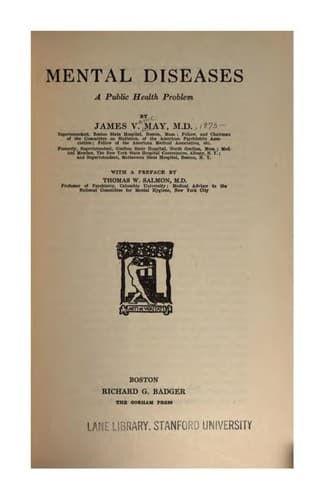
Mental diseases: a public health problemMay, James Vance
Science
Mental diseases: a public health problem
May, James Vance
Mental health services; Psychology, Pathological
"(d) Acute hallucinosis: This is chiefly an auditory hallucinosis of
rapid development with clearness of the sensorium, marked fears, and a
more or less systematized persecutory trend.
"(e) Chronic hallucinosis: This is an infrequent type which may be
regarded as the persistence of the symptoms of the acute hallucinosis
without change in the character of the symptoms except perhaps
a gradual lessening of the emotional reaction accompanying the
hallucinations.
"(f) Acute paranoid type: Suspicions, misinterpretations, and
persecutory ideas, often a jealous trend, hallucinations usually
subordinate; clearing up on withdrawal of alcohol.
"(g) Chronic paranoid type: Persistence of symptoms of the acute
paranoid type with fixed delusions of persecution or jealousy usually
not influenced by withdrawal of alcohol; difficult to differentiate
from non-alcoholic paranoid states or dementia praecox.
"(h) Alcoholic deterioration: A slowly developing ethical, volitional
and emotional change in the habitual drinker; apparently relatively few
cases are committed, as the mental symptoms are not usually looked upon
as sufficient to justify the diagnosis of a definite psychosis. The
chief symptoms are ill humor and irascibility or a jovial, careless,
flippant, facetious mood; abusiveness to family, unreliability and
tendency to prevarication; in some cases definite suspicions and
jealousy; there is a general lessening of efficiency and capacity
for physical and mental work; memory not seriously impaired. To be
excluded are residual defects due to Korsakow's psychosis, or mental
deterioration due to arteriosclerosis or to traumatic lesions.
"(i) Other types, acute or chronic (to be specified)."
Shadwell[222] states that in twenty-six Italian asylums 18.6 per cent
of their cases were directly or indirectly the result of alcoholism.
Twenty-one and one-tenth per cent of the males and 4.37 per cent of
the females admitted to the institutions of Switzerland from 1901 to
1904 were alcoholics. Twenty-one and thirty-seven hundredths per cent
of the admissions to the hospitals in Denmark between 1899 and 1903
were suffering from alcoholic psychoses. He gives the admission rate
in Austria as fourteen per cent and in France, 12.5 per cent. Clouston
some years ago estimated the admission rate in Great Britain and
Ireland to be about twenty per cent.
Public-domain text, read in full here on John Shaqi.
Reviews
Reviews
No reviews yet
Be the first to share your thoughts on this work.
Elsewhere in the archive
Join the Discussion
Join the discussion
Sign in to leave a comment or review.
Sign InorCreate an account