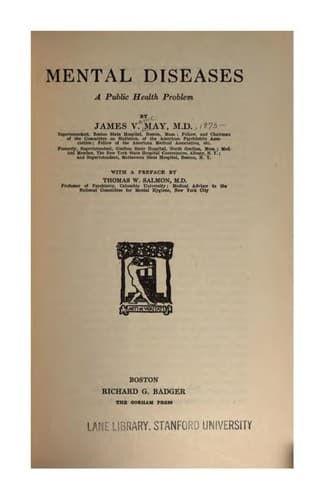
Mental diseases: a public health problemMay, James Vance
Science
Mental diseases: a public health problem
May, James Vance
Mental health services; Psychology, Pathological
Paroled patients made 5,102 of these, discharged patients 265
and others who had no connection with the hospitals at all, 1,836.
In addition to this the hospital social workers made 3,496 visits to
paroled patients as well as four hundred and sixty-two visits to other
patients for the purpose of preventing mental diseases. Situations
were obtained for one hundred and sixty-seven discharged patients. An
enormous amount of work was also done in history taking, etc. Numerous
clinics have been established in Massachusetts by the Department of
Mental Diseases.[28] During the year ending November 30, 1919, a total
of 4,333 visits were reported. Of these 3,057 were first visits. The
number reported by the various hospitals was as follows:—Worcester
State Hospital 1,278, Taunton State Hospital 182, Northampton State
Hospital 458, Danvers State Hospital 282, Westborough State Hospital
177, Grafton State Hospital 129, Gardner Colony 65, Monson State
Hospital 70, Foxborough State Hospital 27, Massachusetts School for
the Feebleminded 541, Boston State Hospital (Psychopathic Department)
2,112. Clinics were maintained in the following localities:—Athol,
Boston, Brockton, Danvers, Fitchburg, Foxborough, Gardner, Grafton,
Gloucester, Greenfield, Haverhill, Lawrence, Lynn, Malden, Medfield,
Monson, New Bedford, Newburyport, Northampton, Pittsfield, Salem,
Springfield, Taunton, Waverley, Westborough, Worcester and Wrentham.
This is a gratifying evidence of progress. There are indications of an
awakening. The hospital treatment of mental diseases will eventually be
conducted on a much higher plane and along lines more nearly comparable
to those of the general hospital. A study of legislation relating to
mental disease shows that efforts are being made very generally to
make their treatment a medical problem rather than a legal question.
It has been no easy matter to obtain treatment for mental diseases,
assuming a desire on the part of the individual to take advantage
of such an opportunity. A review of our legal enactments shows that
as a general rule it means a formal application, properly verified,
an elaborate examination by two qualified physicians, an order of
commitment by the judge of a court of record, a legal notice and an
opportunity for a hearing if one is demanded. Pennsylvania as early
as 1883 made provision for the immediate admission of such cases as
required it, pending the usual court procedure. As has been shown in
another chapter, arrangements have been legalized in many states for
the emergency reception of mental cases, at least for those persons
who are known to be dangerous to themselves or others. Temporary care
enactments have been written into the law in various communities,
making it possible to keep mental cases under observation for a limited
period of time. In a large number of states it is now possible for
a person requesting treatment voluntarily to receive it on his own
application without any other legal formalities.
Public-domain text, read in full here on John Shaqi.
Reviews
Reviews
No reviews yet
Be the first to share your thoughts on this work.
Join the Discussion
Join the discussion
Sign in to leave a comment or review.
Sign InorCreate an account