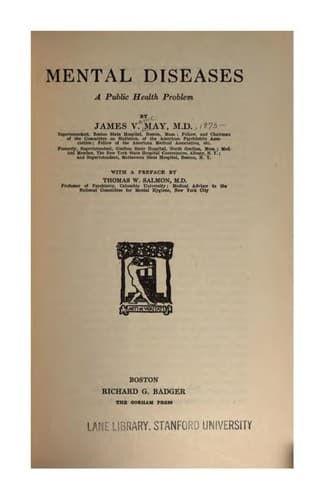
Mental diseases: a public health problemMay, James Vance
Science
Mental diseases: a public health problem
May, James Vance
Mental health services; Psychology, Pathological
Perhaps the greatest
advance is the custom, not so infrequent now, of sending persons held
by courts under a criminal process to a hospital for observation as to
their mental condition. The fact should not be lost sight of that it is
still possible to find "insane" persons in jails, poorhouses and county
institutions in many parts of the country. Worse than this, however, is
the custom of delegating their care to police officers. Nevertheless,
distinct progress has been made.
As has already been shown, a study of methods of care in this country
indicates that every state has passed through several very definite
preliminary stages. These may be summarized as follows:—
1. A period of home care only. During the colonial days mental cases
were cared for at home or not at all. There was nothing else that
could be done for them at the time.
2. Confinement with criminals. In cases of unusual violence, dangerous
persons were confined in jails, lockups and prisons. If necessary,
under certain circumstances the law in some states even authorized the
use of chains.
3. Almshouse care. There has been a time in practically every state
when the poorhouse has been looked upon as the proper place for the
insane.
4. Asylum care. As a result of the agitation of Dorothea Dix and
others, mental diseases were eventually given custodial care in
asylums.
5. Modern hospital care.
In 1894 Dr. S. Weir Mitchell[29] delivered the annual address at
the semi-centennial meeting of the American Medico-Psychological
Association in Philadelphia. It was a very painful occasion for many.
His remarks may be summed up as a vigorous arraignment of the asylum
methods of that day. He severely criticized the public, the state
legislatures, boards of management and the hospital superintendents.
His principal charge was that they were operating asylums along the
lines of the past and were perfectly satisfied with what they had
accomplished. He pointed out the necessity of properly qualified
physicians, more scientific methods and modern treatment. "We have
done with whip and chains and ill usage, and having won this noble
battle have we not rested too easily content with having made the
condition of the insane more comfortable?" It seems incredible that
in the case records of that day he should have found no evidences "of
blood counts, temperatures, reflexes, the eye-ground, color fields, all
the minute examinations with which we are so unrestingly busy." One
institution was unable to furnish Dr. Mitchell with a stethoscope or
an ophthalmoscope! One of his criticisms was that few institutions for
mental diseases had a training school for nurses or any provisions
for hydrotherapy. His last words were almost a prophecy: "Fifty years
hence, when we must all have been swept away, another will possibly
stand in my place and tell your history, and to him and the bountiful
wisdom of time I leave it to be declared whether I was right or wrong."
Dr.
Public-domain text, read in full here on John Shaqi.
Reviews
Reviews
No reviews yet
Be the first to share your thoughts on this work.
Join the Discussion
Join the discussion
Sign in to leave a comment or review.
Sign InorCreate an account