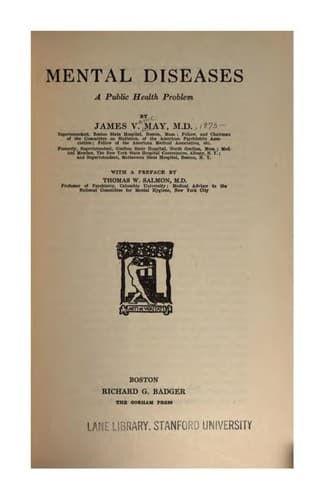
Mental diseases: a public health problemMay, James Vance
Science
Mental diseases: a public health problem
May, James Vance
Mental health services; Psychology, Pathological
4. Psychopathic hospitals. Independent units or integral parts of
a general hospital—with or without facilities for research and
instruction. Designed exclusively for mental cases, without regard
to legal status, whether committed or voluntary, their detailed
examination and careful observation with intensive treatment in the
wards for limited periods when indicated, or their supervision and
direction in out-patient departments, serving also in some instances as
receiving and distributing centers supplying other institutions.
Owing to their limited size, the necessity of treating large numbers in
a short space of time, and the fact that institutional care is already
amply provided for in the existing state hospitals, the obvious field
of the psychopathic hospital is primarily the acute and recoverable
psychoses and the milder forms of mental disorder which may or may
not require a residence in the wards. Only a thorough examination
and a brief period of observation can determine whether or not that
is needed. The question at issue is largely that of determining the
necessity of a more or less indefinite committed status. These problems
arise particularly in dealing with the so-called psychogenic disorders
and the psychopathic states—hysteria, neurasthenia, psychasthenia,
the psychoneuroses in general and the episodes which characterize
the psychopathic personalities. Traumatic psychoses often come into
consideration, as well as cases of cerebrospinal syphilis, toxic
conditions, drug addictions, the psychoses of infection and exhaustion,
and above all, of course, manic-depressive insanity and incipient forms
of dementia praecox. Many of these cases require only a brief hospital
treatment and are able in a short time to return to home surroundings
and resume their former occupations. Often a contact with the chronic
and custodial classes is not only without advantage but actually
detrimental. The psychopathic hospitals thus exercise a sort of
clearing house function and return to the community many patients who
otherwise would be subjected to the stigma, if there is one, of a legal
commitment. While questions relating to the public health cannot be
analyzed in terms of dollars and cents, the saving to the state which
is made by substituting a short period of supervision and treatment,
for a protracted residence in an institution of the custodial class
amounts to millions. In view of the difficulties encountered in
obtaining adequate appropriations for the proper maintenance of the
enormous population now housed in our state hospitals, this is a factor
which cannot be disregarded.
CHAPTER VII
THE MENTAL HYGIENE MOVEMENT
Public-domain text, read in full here on John Shaqi.
Reviews
Reviews
No reviews yet
Be the first to share your thoughts on this work.
Elsewhere in the archive
Join the Discussion
Join the discussion
Sign in to leave a comment or review.
Sign InorCreate an account