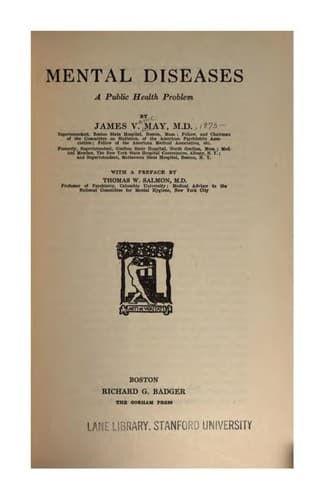
Mental diseases: a public health problemMay, James Vance
Science
Mental diseases: a public health problem
May, James Vance
Mental health services; Psychology, Pathological
As the result of an intimate personal knowledge of the subject,
acquired during an extended hospital residence as a patient in both
public and private institutions, Clifford W. Beers, having recovered
his health, resumed his place in the world profoundly impressed with
the feeling that the question of mental diseases as a public health
problem was one which demanded immediate consideration. In no position
financially to institute a campaign for the purpose of interesting
the public in the importance of topics which had not been made the
subject of general discussion in the past, he was confronted with the
necessity of securing the cooperation and support of persons who had
the means to launch such an undertaking. With this object in view
he wrote his book—"A Mind That Found Itself,"[38] now in its fourth
edition and destined, to use the words of the "American Journal
of Insanity,"[39] "to become one of the classics of psychological
literature." There is some question as to the accuracy with which Mr.
Beers analyzed the experiences through which he had passed. Although
there is no reason for questioning his mental condition when the book
was written, his conclusions were apparently formulated when he had not
as yet had sufficient time in which to readjust himself and recover
his perspective. Some of his viewpoints certainly reflect a morbid
coloring of which he was probably unconscious, although at the time
he recognized in himself "symptoms hardly distinguishable from those
which had obtained eight months earlier when it had been deemed
expedient temporarily to restrict my freedom." His work was referred
to as an "autopathography" by Farrar,[40] who made a detailed study
of the various psychological trends manifested. These are more or
less immaterial. The interesting feature of his book is the elaborate
description of a common but exceedingly important psychosis written
by a well educated observer with a collegiate training. Its greatest
value, however, lies in the fact that he brings home to us so
graphically the overwhelming importance of the personal element so
often overlooked by those who are accustomed to dealing with mental
cases in large numbers. "It carries the reader away from the technical
dissertations, and brings him face to face with the feelings and
reactions of a distorted mind, showing him the patient as a human being
with a sentient soul and not as a case."[41]
Public-domain text, read in full here on John Shaqi.
Reviews
Reviews
No reviews yet
Be the first to share your thoughts on this work.
Elsewhere in the archive
Join the Discussion
Join the discussion
Sign in to leave a comment or review.
Sign InorCreate an account