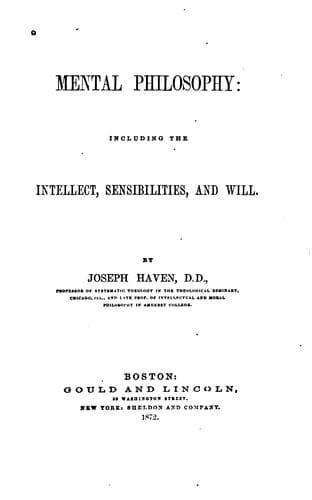
Mental Philosophy: Including the Intellect, Sensibilities, and WillHaven, Joseph
Philosophy
Mental Philosophy: Including the Intellect, Sensibilities, and Will
Haven, Joseph
Psychology
_Confirmation of this View._--It may be argued, as a confirmation of
this view, that whenever mathematical reasoning comes to be applied
to sciences involving facts either as the data, or as objects of
investigation, where it is no longer possible to proceed entirely
upon hypothesis, as, _e. g._, when you apply it to mechanics,
physics, astronomy, practical geometry, etc., then it ceases to be
demonstrative, and becomes merely probable reasoning.
_Mathematical reasoning supposed by some to be identical._--It has been
much discussed whether all mathematical reasoning is merely identical,
asserting, in fact, nothing more than that _a=a_; that a given thing
is equivalent to itself, capable of being resolved at last into merely
this. This view has been maintained by Leibnitz, himself one of the
greatest mathematicians, and by many others. It was for a long time the
prevalent doctrine on the Continent. Condillac applies the same to all
reasoning, and Hobbes seems to have had a similar view, _i. e._, that
all reasoning is only so much addition or subtraction. Against this
view Stewart contends that even if the propositions themselves might be
represented by the formula _a=a_, it does not follow that the various
steps of reasoning leading to the conclusion amount merely to that.
A paper written in cipher may be said to be identical with the same
paper as interpreted; but the evidence on which the act of deciphering
proceeds, amounts to something more than the perception of identity.
And further, he denies that the propositions are identical, _e. g._,
even the simple proposition 2×2=4. 2×2 express one set of quantities,
and 4 expresses another, and the proposition that asserts their
equivalence is not identical; it is not saying that the same quantity
is equal to itself, but that two different quantities are equivalent.
II. PROBABLE REASONING.
_Not opposed to Certainty._--It must be borne in mind, as already
stated, that the probability now intended is not opposed to certainty.
That Cæsar invaded Britain is _certain_, but the reasoning which goes
to establish it, is only probable reasoning, because the thing to be
proved is an event in history, contingent therefore, and not capable
of demonstration.
_Sources of Evidence._--Evidence of this kind of truths is derived from
three sources: 1. Testimony; 2. Experience; 3. Analogy.
1. _Evidence of Testimony._
Public-domain text, read in full here on John Shaqi.
Reviews
Reviews
No reviews yet
Be the first to share your thoughts on this work.
Elsewhere in the archive
Join the Discussion
Join the discussion
Sign in to leave a comment or review.
Sign InorCreate an account