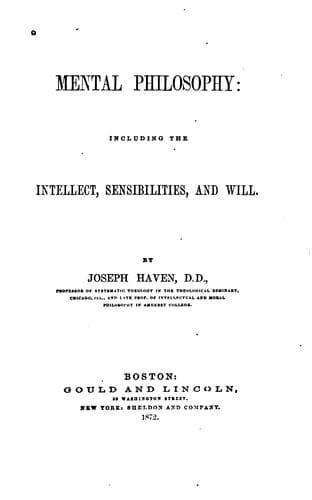
Mental Philosophy: Including the Intellect, Sensibilities, and WillHaven, Joseph
Philosophy
Mental Philosophy: Including the Intellect, Sensibilities, and Will
Haven, Joseph
Psychology
_In itself probable._--This is, à priori, _probable_. We are so
constituted as to be inclined to believe testimony, and it is only when
the incredibility of the witness has been ascertained by sufficient
evidence, that we refuse our assent. The child believes whatever is
told him. The man, long conversant with human affairs, becomes wary,
cautious, suspicious, incredulous. It is remarked by Reid that the
evidence of testimony does not depend altogether on the character of
the witness. If there be no _motive_ for deception, especially if there
be weighty reasons why he should speak truth, or if the narrative be
in itself probable and consistent, and tallies with circumstances, it
is in such cases to be received even from those not of unimpeachable
integrity.
_Limits of Belief._--What are the limits of belief in testimony?
Suppose the character of witnesses to be good, the narrative
self-consistent, the testimony concurrent of various witnesses,
explicit, positive, full, no motive for deception; are we to believe
in that case whatever may be testified? One thing is certain, we do in
fact believe in such cases; we are so constituted. Such is the law of
our nature. Nor can it be shown irrational to yield such assent. It has
been shown by an eminent mathematician that it is always possible to
assign a number of independent witnesses, so great that the falsity of
their concurrent testimony shall be mathematically more improbable, and
so more incredible, than the truth of their statement, _be it what it
may_.
Public-domain text, read in full here on John Shaqi.
Reviews
Reviews
No reviews yet
Be the first to share your thoughts on this work.
Elsewhere in the archive
Join the Discussion
Join the discussion
Sign in to leave a comment or review.
Sign InorCreate an account