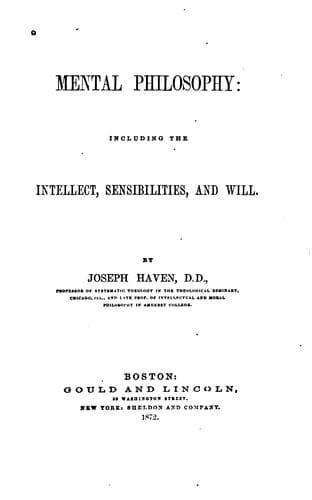
Mental Philosophy: Including the Intellect, Sensibilities, and WillHaven, Joseph
Philosophy
Mental Philosophy: Including the Intellect, Sensibilities, and Will
Haven, Joseph
Psychology
_This not absolute Identity._--In the cases now under consideration, in
which, in popular language, objects are termed "same" and "identical,"
which are not strictly so, there is _comparative_ rather than
_absolute_ unity and identity. There is reference always in such cases
to other objects of the same kind, sort, and description, a series of
which the object of present cognition is one, and to which series it
holds the same relation now that it held formerly. As when, of several
books on a table, you touch _one_, and after the interval of some
moments or hours touch the same again; you say, The book I last touched
is the same I touched before, the _identical_ one; you do not mean that
its _substance_ is absolutely unchanged, that it has the same precise
number of particles in its composition as before--this is not in your
mind at all--but only that the unity thus designated is the same unity
previously designated, that, and not some other one of the series of
similar objects. It is a _comparative_ idea, a comparative identity, in
which numerical unity is the element chiefly regarded.
_Possible Plurality implied._--In all cases where the idea of identity
arises in the mind, there is implied a _possible_ plurality of
objects of the same general character; the idea of such diversity or
plurality is before the mind, and the foundation of that idea is the
difference of cognition. The same object is viewed by the same person
at _different times_ or by _different persons_ at the same time, and
in that case, though the object itself should be absolutely one and
the same, yet there have been distinct, separate cognitions of it, and
this plurality or difference of cognition is a sufficient foundation
for the idea of a possible diversity of object. The book _as known_
to-day and the book _as known_ yesterday, are two distinct objects of
thought. The cognition now, and the cognition then, are two separate
acts of the mind; and the question arises, Are the _objects_ distinct,
as well as the cognitions? This is the question of identity. You have
an immediate, irresistible conviction that the object of these several
cognitions is one and the same. You affirm its identity, absolute or
comparative, as the case may be.
Public-domain text, read in full here on John Shaqi.
Reviews
Reviews
No reviews yet
Be the first to share your thoughts on this work.
Elsewhere in the archive
Join the Discussion
Join the discussion
Sign in to leave a comment or review.
Sign InorCreate an account