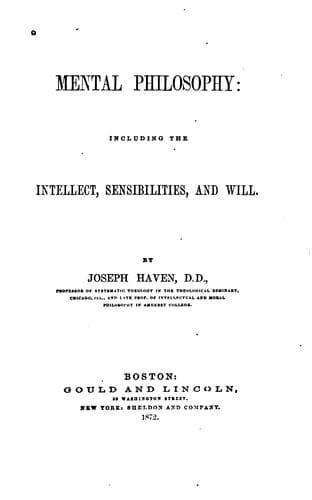
Mental Philosophy: Including the Intellect, Sensibilities, and WillHaven, Joseph
Philosophy
Mental Philosophy: Including the Intellect, Sensibilities, and Will
Haven, Joseph
Psychology
_Definitions combining both Elements._--The greater number, however,
of those who have written on this subject, have combined in their
definitions of taste both these elements, the power of perceiving and
the power of feeling. So Burke: "That faculty, or those faculties of
the mind which _are affected with_, or which _form a judgment of_, the
works of imagination and the elegant arts." Alison: "That faculty of
the mind by which we _perceive_ and _enjoy_ whatever is beautiful or
sublime in the works of nature and art." Reid also makes it consist in
"the power of discerning and relishing" these objects. Voltaire makes
the feeling quite as essential as the perception. Benard, Professor of
Philosophy in the College Royal at Rouen, in the excellent article on
taste, in the Dictionnaire des Sciences Philosophiques, defines taste
as "that faculty of the mind which makes us to discern and feel the
beauties of nature, and whatever is excellent in works of art." It
is a compound faculty, according to this author, inhabiting at once
both worlds, that of sense and that of reason. Beauty reveals itself
to us only under sensible forms, the faculty which contemplates the
beautiful, therefore, seizes it only in its sensible manifestation. The
pure idea, on the other hand, in its abstract nature, addresses not the
taste but the understanding; it appears to us, not as the beautiful,
but as the true. Taste, then, has to do with sense. Still, says Benard,
"the essential element which constitutes it, pertains to the reason;
it is, in truth, only one of the forms of this sovereign power, which
takes different names according to the objects which it deals with;
_reason_, properly speaking, when it employs itself in the sphere of
speculative truth; _conscience_, when it reveals to us truths moral or
practical; _taste_, when it appreciates the beauty and suitableness of
objects in the real world, or of works of art."
_These three Classes comprehensive._--Other authorities and
definitions, almost without number, might be added, but they fall
essentially under the three classes now specified. Which of these
views, then, is the correct and true one? is the question now before
us. Is taste a matter of feeling, or is it an intellectual discernment,
or is it both? Evidently we cannot depend on authority for the decision
of this question, since authorities differ. We must examine for
ourselves.
Public-domain text, read in full here on John Shaqi.
Reviews
Reviews
No reviews yet
Be the first to share your thoughts on this work.
Elsewhere in the archive
Join the Discussion
Join the discussion
Sign in to leave a comment or review.
Sign InorCreate an account