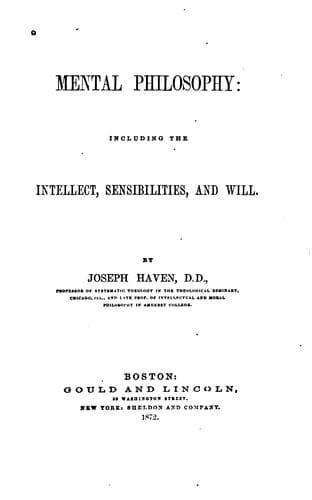
Mental Philosophy: Including the Intellect, Sensibilities, and WillHaven, Joseph
Philosophy
Mental Philosophy: Including the Intellect, Sensibilities, and Will
Haven, Joseph
Psychology
_Result of the preceding Inquiries._--We have, as yet, found no
satisfactory explanation of the origin of our moral ideas and
perceptions. They seem not to be the result of education and
imitation, nor yet of legal enactment. They seem to be natural, rather
than artificial and acquired. Yet we cannot trace them to the action
of the sensitive part of our nature. They are not the product of a
special sense, nor yet of the combined and associated action of certain
natural emotions, much less of any one emotion, as sympathy. And yet
they are a part of our nature. Place man where you will, surround him
with what influences you will, you still find in him, to some extent
at least, indications of a moral nature; a nature modified, indeed, by
circumstances, but never wholly obliterated. Evidently we must refer
the ideas in question, then, to the intellectual, since they do not
belong to the sensitive part of our nature.
5. _Judgment._--Are they then the product and operation of the faculty
of judgment? But the judgment does not _originate_ ideas. It compares,
distributes, estimates, decides to what class and category a thing
belongs, but creates nothing. I have in mind the idea of a triangle,
a circle, etc. So soon as certain figures are presented to the eye,
I refer them at once, by an act of judgment, to the class to which
they belong. I affirm that to be a triangle, this, a circle, etc.;
the judgment does this. But judgment does not furnish my mind with
the primary idea of a circle, etc. It deals with this idea already in
the mind. So in our judgment of the beauty and deformity of objects.
The perception that a landscape or painting is beautiful, is, in one
sense, an act of judgment; but it is an act which presupposes the idea
of the beautiful already in the mind that so judges. So also of moral
distinctions. Whence comes the _idea_ of right and wrong which lies at
the foundation of every particular judgment as to the moral character
of actions? This is the question before us, still unanswered; and to
this there remains but one reply.
Public-domain text, read in full here on John Shaqi.
Reviews
Reviews
No reviews yet
Be the first to share your thoughts on this work.
Elsewhere in the archive
Join the Discussion
Join the discussion
Sign in to leave a comment or review.
Sign InorCreate an account