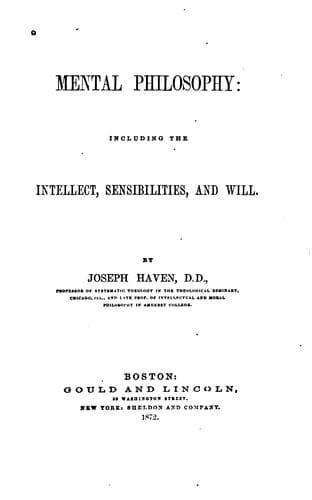
Mental Philosophy: Including the Intellect, Sensibilities, and WillHaven, Joseph
Philosophy
Mental Philosophy: Including the Intellect, Sensibilities, and Will
Haven, Joseph
Psychology
6. _These Ideas intuitive._--The ideas in question are _intuitive_;
suggestions or perceptions of _reason_. The view now proposed may be
thus stated: It is the office of reason to discern the right and
the wrong, as well as the true and the false, the beautiful and the
reverse. Regarded subjectively, as conceptions of the human mind,
right and wrong, as well as beauty and its opposite, truth and its
opposite, are simple ideas, incapable of analysis or definition;
_intuitions of reason_. Regarded as objective, right and wrong are
realities, qualities absolute, and inherent in the nature of things,
not fictitious, not the play of human fancy or human feeling, not
relative merely to the human mind, but independent, essential,
universal, absolute. As such, reason recognizes their existence.
Judgment decides that such and such actions do possess the one or the
other of these qualities; are right or wrong actions. There follows
the sense of obligation to do or not to do, and the consciousness of
merit or demerit as we comply, or fail to comply, with the same. In
view of these perceptions emotions arise, but only as based upon them.
The emotions do not, as the sentimental school affirm, originate the
idea, the perception; but the idea, the perception, gives rise to the
emotion. We are so constituted as to feel certain emotions in view of
the moral quality of actions, but the idea and perception of that moral
quality must _precede_, and it is the office of reason to produce this.
_First Truths._--There are certain simple ideas which must be regarded
as first truths, or first principles, of the human understanding,
essential to its operations, ideas universal, absolute, necessary. Such
are the ideas of personal existence, and identity, of time and space,
as conditions of material existence; of number, cause, and mathematical
relation. Into this class fall the ideas of the true, the beautiful,
the right, and their opposites. The fundamental maxims of reasoning and
morals find here their place.
_How awakened._--These are, in a sense, intuitive perceptions; not
strictly innate, yet connate; the foundation for them being laid in our
nature and constitution. So soon as the mind reaches a certain stage
of development they present themselves. Circumstances may promote
or retard their appearance. They depend on opportunity to furnish
the occasion of their springing up, yet they are, nevertheless, the
natural, spontaneous development of the human soul, as really a part
of our nature as are any of our instinctive impulses, or our mental
attributes. They are a part of that native intelligence with which we
are endowed by the author of our being. These intuitions of ours, are
not themselves the foundation of right and wrong; they do not make one
thing right and another wrong; but they are simply the reason why we so
regard them. Such we believe to be the true account of the origin of
our moral perceptions.
§ II.--COGNIZANCE OF THE RIGHT.
Public-domain text, read in full here on John Shaqi.
Reviews
Reviews
No reviews yet
Be the first to share your thoughts on this work.
Elsewhere in the archive
Join the Discussion
Join the discussion
Sign in to leave a comment or review.
Sign InorCreate an account