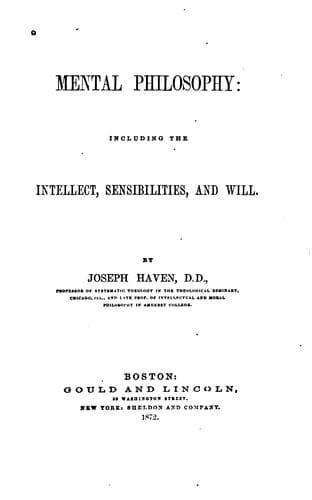
Mental Philosophy: Including the Intellect, Sensibilities, and WillHaven, Joseph
Philosophy
Mental Philosophy: Including the Intellect, Sensibilities, and Will
Haven, Joseph
Psychology
_Questions which present themselves._--Without further consideration of
this point, we pass at once to the investigation of the subject itself.
Our inquiries relate principally to the _nature_ and _authority_ of
this faculty. On these points, it is hardly necessary to say, great
difference of opinion has existed among philosophers and theologians,
and grave questions have arisen. What _is_ this faculty as exercised; a
judgment, a process of reasoning, or an emotion? Does it belong to the
rational or sensitive part of our nature: to the domain of intellect,
or of feeling, or both? What is the value and correctness of our
moral perceptions, and especially of that verdict of _approbation_ or
_censure_, which we pass upon ourselves and others, according as the
conduct conforms to, or violates, recognized obligation? Such are some
of the questions which have arisen respecting the nature and authority
of conscience.
I. _The Nature of Conscience._--What is it? A matter of _intellect_, or
of _feeling_; a _judgment_, or an _emotion_?
A careful analysis of the phenomena of conscience, with a view to
determine the several elements, or mental processes, that constitute
its operation, may aid us in the solution of this question.
ANALYSIS OF AN ACT OF CONSCIENCE.
_Cognition of Right._--Whenever the conduct of intelligent and rational
beings is made the subject of contemplation, whether the act thus
contemplated be our own or another's, and whether it be an act already
performed, or only proposed, we are cognizant of certain ideas awakened
in the mind, and of certain impressions made upon it. First of all,
the act contemplated strikes us as _right_ or _wrong_. This involves
a double element, an _idea_, and a _perception_ or _judgment_. The
_idea_ of right and its opposite are, in the mind, simple ideas, and,
therefore, indefinable. In the act contemplated, we _recognize_ the one
or the other of these simple elements, and pronounce it, accordingly,
a right or wrong act. This is simply a _judgment_, a perception, an
exercise of the understanding.
Public-domain text, read in full here on John Shaqi.
Reviews
Reviews
No reviews yet
Be the first to share your thoughts on this work.
Elsewhere in the archive
Join the Discussion
Join the discussion
Sign in to leave a comment or review.
Sign InorCreate an account