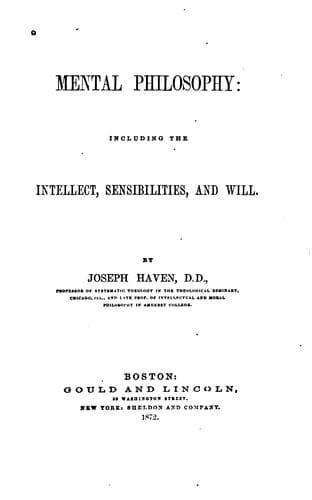
Mental Philosophy: Including the Intellect, Sensibilities, and WillHaven, Joseph
Philosophy
Mental Philosophy: Including the Intellect, Sensibilities, and Will
Haven, Joseph
Psychology
_Of Obligation._--No sooner is this idea, this cognition, of the
rightness or wrongness of the given act, fairly entertained by
the mind, than another idea, another cognition, presents itself,
given along with the former, and inseparable from it, viz., that of
_obligation_ to do, or not to do, the given act: the _ought_, and
the _ought not_--also simple ideas, and indefinable. This applies
equally to the future and to the past, to ourselves and to others:
I ought to do this thing. I ought to _have done_ it yesterday. He
ought, or ought not to do, or to have done it. This, like the former,
is an intellectual act, a perception or cognition of a truth, of a
reality for which we have the same voucher as for any other reality
or apprehended fact, viz., the reliability of our mental faculties
in general, and the correctness of their operation in the specific
instance. It is a conviction of the mind inseparable from the
perception of right. Given, a clear perception of the one, and we
cannot escape the other.
_Of Merit and Demerit._--There follows a third element, logically
distinct, but chronologically inseparable, from the preceding: the
cognition of merit or demerit in connection with the deed, of good
or ill desert, and the consequent approval or disapproval of the
deed and the doer. No sooner do we perceive an action to be right
or wrong, and to involve, therefore, an obligation on the part of
the doer, than, there arises, also, in the mind, the idea of merit
or demerit, in connection with the doing; we regard the agent as
deserving of praise or blame, and in our own minds do approve or
condemn him and his course, accordingly. This approval of ourselves
and others, according to the apprehended desert of the act and the
actor, constitutes a process of trial, an inner tribunal, at whose bar
are constantly arraigned the deeds of men, and whose verdict it is no
easy matter to set aside. This mental approval may be regarded by some
as a matter of feeling, rather than an intellectual act. We speak of
_feelings_ of approval and of condemnation. To approve and condemn,
however, are, properly, acts of the judgment. The feelings consequent
upon such approval or disapproval are usually of such a nature, and
of such strength, as to attract the principal attention of the mind
to themselves, and, hence, we naturally come to think and speak of
the whole process as a matter of feeling. Strictly viewed, it is an
intellectual perception, an exercise of judgment, giving sentence that
the contemplated act is, or is not, meritorious, and awarding praise or
blame accordingly.
This completes the process. I can discover nothing in the operation of
my mind, in view of moral action, which does not resolve itself into
some one of these elements.
Public-domain text, read in full here on John Shaqi.
Reviews
Reviews
No reviews yet
Be the first to share your thoughts on this work.
Elsewhere in the archive
Join the Discussion
Join the discussion
Sign in to leave a comment or review.
Sign InorCreate an account