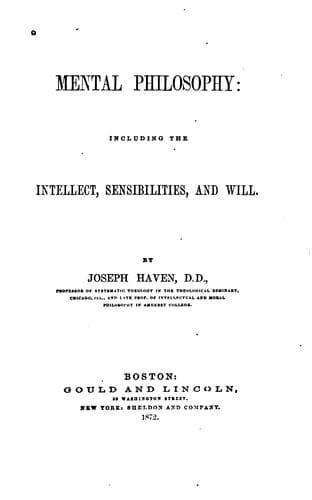
Mental Philosophy: Including the Intellect, Sensibilities, and WillHaven, Joseph
Philosophy
Mental Philosophy: Including the Intellect, Sensibilities, and Will
Haven, Joseph
Psychology
_These Elements intellectual._--Viewed in themselves, these are,
strictly, intellectual operations; the recognition of the right, the
recognition of obligation, the perception of good or ill desert, are
all, properly, acts of the intellect. Each of these cognitive acts,
however, _involves a corresponding action of the sensibilities_. The
perception of the right awakens, in the pure and virtuous mind,
feelings of pleasure, admiration, love. The idea of obligation becomes,
in its turn, through the awakened sensibilities, an impulse and motive
to action. The recognition of good or ill desert awakens feelings of
esteem and complacency, or the reverse; fills the soul with sweet
peace, or stings it with sharp remorse. All these things must be
recognized and included by the psychologist among the phenomena of
conscience. These emotions, however, are based on, and grow out of, the
intellectual acts already named, and are to be viewed as an incidental
and subordinate, though by no means unimportant, part of the whole
process. When we speak of conscience, or the moral faculty, we speak of
a _power_, a faculty and not _merely_ a feeling or susceptibility of
being affected. It is a cognitive power, having to do with realities,
recognizing real distinctions, and not merely a passive play of the
sensibilities. It is simply the mind's power of recognizing a certain
class of truths and relations. As such, we claim for it a place among
the strictly cognitive powers of the mind, among the faculties that
have to do with the perception of truth and reality.
Public-domain text, read in full here on John Shaqi.
Reviews
Reviews
No reviews yet
Be the first to share your thoughts on this work.
Elsewhere in the archive
Join the Discussion
Join the discussion
Sign in to leave a comment or review.
Sign InorCreate an account