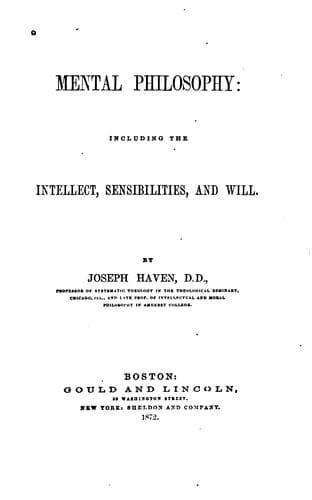
Mental Philosophy: Including the Intellect, Sensibilities, and WillHaven, Joseph
Philosophy
Mental Philosophy: Including the Intellect, Sensibilities, and Will
Haven, Joseph
Psychology
_Importance of this Position._--This is a point of some importance.
If, with certain writers, we make the moral faculty a matter of mere
feeling, overlooking the intellectual perceptions on which this
feeling is based, we overlook and leave out of the account, the chief
elements of the process. The moral faculty is no longer a cognitive
power, no longer, in truth, a faculty. The distinctions which it
seems to recognize are merely _subjective_; impressions, feelings,
to which there may, or may not, be a corresponding reality. We have
at least no evidence of any such reality. Such a view subtracts the
very foundation of morals. Our feelings vary; but right and wrong do
not vary with our feelings. They are objective realities, and not
subjective phenomena. As such, the mind, by virtue of the natural
powers with which it is endowed by the Creator, recognizes them. The
power by which it gives this, we call the _moral faculty_; just as
we call its power to take cognizance of another class of truths and
relations, viz., the beautiful, its _æsthetic_ faculty. In view of
these truths and relations, as thus perceived, certain feelings are,
in either case, awakened, and these emotions may, with propriety, be
regarded as pertaining to, and a part of, the phenomena of conscience,
and of taste; the full discussion of either of these faculties will
include the action of the sensibilities; but in neither case will a
true psychology resolve the faculty into the feeling. The mathematician
experiences a certain feeling of delight in perceiving the relation
of lines and angles, but the power of perceiving that relation, the
faculty by which the mind takes cognizance of such truth, is not to be
resolved into the feeling that results from it.
_Result of Analysis._--As the result of our analysis, we obtain the
following elements as involved in, and constituting, an operation of
the moral faculty:
(1.) The mental perception that a given act is right or wrong.
(2.) The perception of obligation with respect to the same, as right or
wrong.
(3.) The perception of merit or demerit, and the consequent approbation
or censure of the agent, as doing the right or the wrong thus perceived.
(4.) Accompanying these intellectual perceptions, and based upon them,
certain corresponding emotions, varying in intensity according to the
clearness of the mental perceptions, and the purity of the moral nature.
II. _Authority of Conscience._--Thus far we have considered
the _nature_ of conscience. The question arises now as to its
_authority_--the reliableness of its decisions.
If conscience correctly discerns the right and the wrong and the
consequent obligation, it will be likely to judge correctly as to the
deserts of the doer. If it mistake these points, it may approve what is
not worthy of approval, and condemn what is good.
Public-domain text, read in full here on John Shaqi.
Reviews
Reviews
No reviews yet
Be the first to share your thoughts on this work.
Elsewhere in the archive
Join the Discussion
Join the discussion
Sign in to leave a comment or review.
Sign InorCreate an account