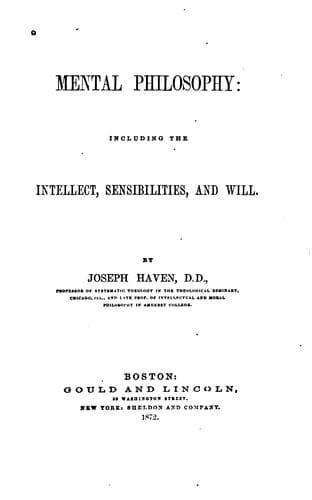
Mental Philosophy: Including the Intellect, Sensibilities, and WillHaven, Joseph
Philosophy
Mental Philosophy: Including the Intellect, Sensibilities, and Will
Haven, Joseph
Psychology
_Conscience not exclusively intellectual._--I have discussed, as
I proposed, the _nature_ and _authority_ of conscience. In this
discussion I have treated of the moral faculty as an intellectual,
rather than an emotional power I would not be understood, however, as
implying that conscience has not also an emotional character. Every
intellectual act, and faculty of action, partakes more or less of this
character, is accompanied by feeling, and these feelings are in some
degree peculiar, it may be, to the particular faculty or act of mind
to which they relate. The exercise of imagination involves some degree
of feeling, either pleasurable or painful, and that often in a high
degree; so also the æsthetic faculty. It is peculiarly so with the
exercise of the moral faculty. As already stated, in our analysis of an
act of conscience, it is impossible to view our past conduct as right
or wrong, and to approve or condemn ourselves accordingly, without
emotion; and these emotions will vary in intensity, according to the
clearness and force of our intellectual conception of the merit or
demerit of our conduct.
These feelings constitute an important part of the phenomena of moral
action, and consequently of psychology; as they belong, however, to the
department of _sensibility_, rather than of _intellect_, their further
discussion is not here in place. They will be considered in connection
with other emotions in the subsequent division of the work.
INTELLECTUAL FACULTIES
SUPPLEMENTARY TOPICS.
CHAPTER I.
INSTINCT.--THE INTELLIGENCE OF THE BRUTE AS DISTINGUISHED FROM THAT OF
MAN.
Closely connected with the philosophy of human intelligence is the
science of _instinct_, or the intelligence of the brute--a subject of
interest not merely in its relations to psychology, but to some other
sciences, as natural history, and theology.
_We work at a Disadvantage in such Inquiries._--With regard to this
matter, it must be confessed, at the outset, that we work, in some
respects, in the dark, in our inquiries and speculations concerning it.
It lies wholly removed from the sphere of consciousness. We can only
observe, compare, and infer, and our conclusions thus derived must be
liable, after all, to error. The operations of our own minds we know
by the clearest and surest of all sources of knowledge, viz., our own
consciousness; the operation of brute intelligence must ever be in
great measure unknown and a mystery to us. How far the two resemble
each other, and how far they differ, it is not easy to determine, not
easy to draw the dividing line, and say where brute intelligence stops
and human intelligence begins.
_Method proposed._--Let us first define instinct, the term usually
applied to denote brute intelligence, and ascertain, if possible, what
are its peculiar characteristics; we may then be able to determine
wherein it differs from intelligence in man.
Public-domain text, read in full here on John Shaqi.
Reviews
Reviews
No reviews yet
Be the first to share your thoughts on this work.
Elsewhere in the archive
Join the Discussion
Join the discussion
Sign in to leave a comment or review.
Sign InorCreate an account