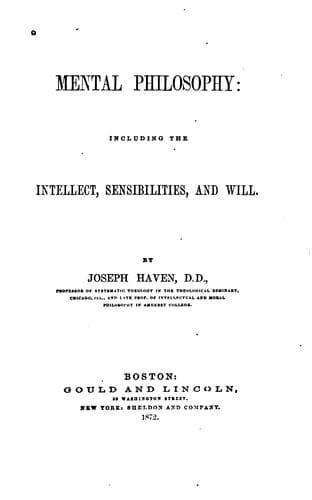
Mental Philosophy: Including the Intellect, Sensibilities, and WillHaven, Joseph
Philosophy
Mental Philosophy: Including the Intellect, Sensibilities, and Will
Haven, Joseph
Psychology
_Definition._--I understand, by instinct, a law of action, governing
and directing the movement of sentient beings--distinct, on the
one hand, from the mere blind forces of matter, as attraction,
etc., and from reason on the other; a law working to a given end by
impulse, yet blindly--the subject not knowing why he thus works;
a law innate, inherent in the constitution of the animal, not
acquired but transmitted, the origin of which is to be found in the
intelligent author of the universe. These I take to be the principal
characteristics of that which we term instinct.
_Instinct a Law._--It is a _law of action_. In obedience to it the bee
constructs her comb, and the ant her chambers, and the bird her nest;
and in obedience to it, the animal, of whatever species, seeks that
particular kind of food which is intended and provided for it. These
are merely instances of the operation of that law. The uniformity and
universality which characterize the operations of this principle, show
it to be a law of action, and not a merely casual occurrence.
_Works by Impulse._--It is a law _working by impulse_, not mechanical
or automatic, on the one hand, nor yet rational on the other. The
impelling or motive force, in the case supposed, is not that of a
weight acting upon machinery, or any like mechanical principle, nor yet
the reflex action of a nerve when irritated, or the spasmodic action of
a muscle. It is not analogous to the influence of gravitation on the
purely passive forms of matter. Nor yet is it that higher principle
which we term reason in man. The bird constructs her nest as she does,
and the bee her cell, in obedience to some blind yet powerful and
unfailing _impulse_ of her nature, guiding and directing her movements,
prompting to action, and to this specific form of action, with a
restless yearning, unsatisfied until the end is accomplished. Yet the
creature does not herself understand the law by which she works. The
bee does not know that she constructs her comb at that precise angle
which will afford the greatest content in the least space, does not
know why she constructs it at that precise angle, could give no reason
for her procedure, even were she capable of understanding our question.
It is not with her a matter of reflection, nor of reason, at all, but
merely of blind, unthinking, yet unerring impulse.
Public-domain text, read in full here on John Shaqi.
Reviews
Reviews
No reviews yet
Be the first to share your thoughts on this work.
Elsewhere in the archive
Join the Discussion
Join the discussion
Sign in to leave a comment or review.
Sign InorCreate an account