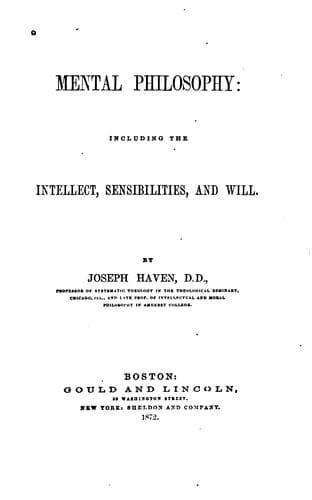
Mental Philosophy: Including the Intellect, Sensibilities, and WillHaven, Joseph
Philosophy
Mental Philosophy: Including the Intellect, Sensibilities, and Will
Haven, Joseph
Psychology
_As innate._--This law is _innate_, _inherent_ in the constitution of
the animal, _not acquired_. It is not the result of education. The
bird does not learn to build her nest, nor the bee her comb, nor the
ant her subterranean chambers, by observing how the parent works and
builds. Removed from all opportunities of observation or instruction,
the untaught animal still performs its mission, constructs its nest or
cell, and does it as perfectly in solitude as among its fellows, as
perfectly on the first attempt as ever after. Whatever intelligence
there is involved in these labors and constructions, and certainly
the very highest intelligence would seem, in many instances, to be
concerned in them, is an intelligence transmitted, and not acquired,
the origin of which is to be sought, ultimately, not in the creature
itself, but in the Author of all intelligence, the Creator of the
universe. The intelligence is that not of the creature, but of the
Creator.
_Manifests itself irrespective of Circumstance._--It is to be further
observed, with respect to the principle under consideration, that it
often manifests its peculiar tendencies prior to the development of
the appropriate organs. The young calf butts with its head before its
horns are grown. The instinctive impulse manifests itself, also, under
circumstances which render its action no longer needful. The beaver
caught and confined in a room, constructs its dam, as aforetime,
with whatsoever materials it can command, although, in its present
circumstances, such a structure is of no possible use. These facts
evidently indicate the presence and action of an impulse working
blindly, without reflection, without reason, without intelligence, on
the part of the animal.
_Indications of Contrivance._--On the other hand, there are instances
of brute action which seem to indicate contrivance and adaptation to
circumstances. The bee compelled to construct her comb in an unusual
and unsafe position, steadies it by constructing a brace of wax-work
between the side that inclines and the nearest wall of the hive. The
spider, in like manner, whose web is in danger, runs a line, from
the part exposed to the severest strain or pressure, to the nearest
point of support, in such a manner as to secure the slender fabric. A
bird has been known, in like manner, to support a bough, which proved
too frail to sustain the weight of the nest, and of her young, by
connecting it, with a thread, to a stronger branch above.
Public-domain text, read in full here on John Shaqi.
Reviews
Reviews
No reviews yet
Be the first to share your thoughts on this work.
Elsewhere in the archive
Join the Discussion
Join the discussion
Sign in to leave a comment or review.
Sign InorCreate an account