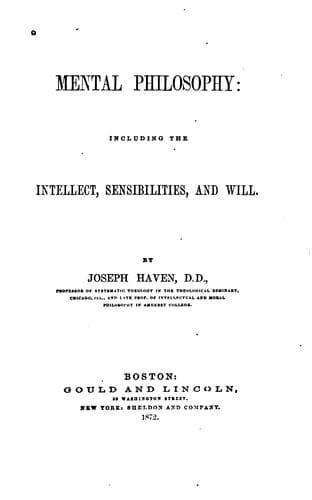
Mental Philosophy: Including the Intellect, Sensibilities, and WillHaven, Joseph
Philosophy
Mental Philosophy: Including the Intellect, Sensibilities, and Will
Haven, Joseph
Psychology
As joy has its opposite, sorrow, and love its opposite, hate, so also
desire has its opposite, aversion; and the objects of aversion are
as numerous as the objects of desire. The desire of wealth has its
counterpart, the aversion to poverty and want; the desire of life and
happiness stands over against the aversion to suffering and death. The
two are so to speak, the positive and negative poles of feeling.
_Hope and Fear._--There is yet another and important class of our
emotions, having not a little to do with the happiness or misery of
life, casting its lights and shadows over no small part of our little
path from the cradle to the grave, our _hopes_ and our _fears_. These,
however important in themselves, are, nevertheless, but modifications
of the principles of desire and aversion, and are, therefore, to be
referred to the same general division of the sensibilities. Hope is the
desire of some expected good, fear the aversion to some anticipated
evil.
_Summary of Classes._--To the three comprehensive classes now named,
_Simple Emotions_, _Affections_, and _Desires_ may be referred, if
I mistake not, the various sensibilities of our nature; or, if the
analysis and classification be not complete and exhaustive, it is at
least sufficiently minute for our present purpose.
HISTORICAL SKETCH OF THE LEADING DIVISIONS OF THE SENSIBILITIES ADOPTED
BY DIFFERENT WRITERS.
_Important to know the Principles of Division adopted by others._--The
discussion of the present topic would be incomplete without a glance
at the _history_ of the same. It is of service, having obtained some
definite results and conclusions of our own, to know also what have
been the views and conclusions of others upon the same matter. As
with regard to the intellectual powers, so also with respect to the
sensibilities, different principles of division and classification have
been adopted by different writers. Our limits will allow us to glance
only at the more important of these.
_General Principles of Classification._--Of those who have written upon
the sensibilities, some have placed them in contrast to each other,
as hope and fear, love and hate, etc., making this the principle of
division; others have classed them as personal, social, etc.; others
as relating to time, the past, the present, and the future; others as
instinctive and rational; while most who have had occasion to treat of
this part of our mental constitution, have considered it with reference
solely or mainly to the science of ethics or morals, and have adopted
such a division and arrangement as best suited that end, without
special regard to the psychology of the matter.
_Of the Greek Schools._--Among the Greeks, the Academicians included
the various emotions under the four principal ones, fear, desire, joy,
and grief, classing despair and aversion under grief, while hope,
courage, and anger were comprised under desire.
Public-domain text, read in full here on John Shaqi.
Reviews
Reviews
No reviews yet
Be the first to share your thoughts on this work.
Elsewhere in the archive
Join the Discussion
Join the discussion
Sign in to leave a comment or review.
Sign InorCreate an account