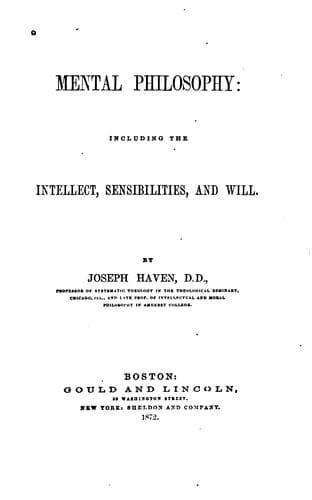
Mental Philosophy: Including the Intellect, Sensibilities, and WillHaven, Joseph
Philosophy
Mental Philosophy: Including the Intellect, Sensibilities, and Will
Haven, Joseph
Psychology
To denote the _passivity_ of the mind, as acted upon, and under the
influence of emotion, the Greeks named the passions in general, [Greek:
pathos], suffering, whence our terms pathos, pathetic, etc., whence
also the Latin _passio_ and _patior_, from which our word _passion_.
The Stoics, in particular, designated all emotions as [Greek: pathê],
diseases, regarding them as disorders of the mind.
_Hartley's Division._--Among the moderns, _Hartley_ divides the
sensibilities into the two leading classes of _grateful_ and
_ungrateful_ ones; under the former, including love, desire, hope, joy,
and pleasing recollection; under the latter, the opposites of these
emotions, hatred, aversion, fear, grief displeasing recollection.
_Distinction of primitive and derivative._--Certain other English
writers, as _Watts_ and _Grove_, derive all the emotions ultimately
from the three principal ones, admiration, love, and hatred, which they
term the _primitive_ passions, all others being _derivative_.
_Division of Cogan._--_Cogan_, whose treatise on the passions is a
work of much interest, divides the sensibilities into _passions_,
_emotions_, and _affections_; by the first of these terms designating
the first impression which the mind receives from some impulsive cause;
by the second, the more permanent feeling which succeeds, and which
betrays itself by visible signs in the expressions of the countenance
and the motions of the body; while by affections, he denotes the less
intense and more durable influence exerted upon the mind by the objects
of its regard. The passions and affections are, by this author, further
divided into those which spring from _self-love_ and those which are
derived from the _social principle_.
_Classification of Dr. Reid._--_Dr. Reid_ divides the active
principles, as he terms them, into three classes, the _mechanical_, the
_animal_, and the _rational_, including, under the first, our instincts
and habits, under the second, our appetites, under the third, our
higher principles of action.
_Of Stewart._--_Dugald Stewart_ makes two classes, the _instinctive_
or _implanted_, and the _rational_ or _governing_ principles, under
the former including _appetites_, _desires_, and _affections_, under
the latter, _self-love_ and the _moral faculty_. The desires are
distinguished from the appetites, in that they do not, like the former,
take their rise from the body, nor do they operate, periodically, after
certain intervals, and cease after the attainment of their object.
Under the title of affections, are comprehended all those principles of
our nature that have for their object the communication of good or of
ill to others.
Public-domain text, read in full here on John Shaqi.
Reviews
Reviews
No reviews yet
Be the first to share your thoughts on this work.
Elsewhere in the archive
Join the Discussion
Join the discussion
Sign in to leave a comment or review.
Sign InorCreate an account