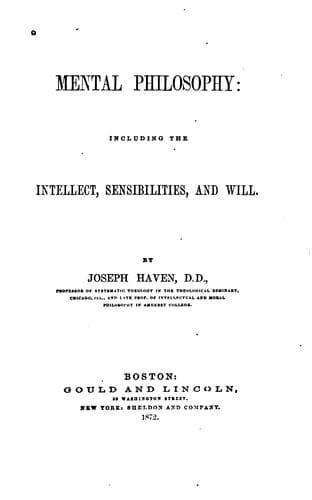
Mental Philosophy: Including the Intellect, Sensibilities, and WillHaven, Joseph
Philosophy
Mental Philosophy: Including the Intellect, Sensibilities, and Will
Haven, Joseph
Psychology
_Of Brown._--_Dr. Brown_ divides the sensibilities, to which he gives
the general name of _emotions_, with reference to their relation
to _time_, as _immediate_, _retrospective_, and _prospective_.
Under the former, he includes, as involving no moral feeling,
cheerfulness and melancholy, wonder and its opposite, feelings of
beauty and the opposite, feelings of sublimity and of the ludicrous;
as involving moral feeling, the emotions distinctive of vice and
virtue, emotions of love and hate, of sympathy, of pride and humility.
Under _retrospective_ emotion he includes anger, gratitude, regret,
satisfaction; under _prospective_ emotion, all our desires and fears.
_Of Upham._--Prof. Upham divides the sensibilities into the two leading
departments, the _natural_ and the _moral_, the former comprehending
the _emotions_ and the _desires_, the latter, the _moral sentiments_ or
_conscience_. Under the class of desires, he includes our instincts,
appetites, propensities, and affections.
_Of Hickok._--Dr. Hickok classes the sensibilities under the
departments of _animal_, _rational_, and _spiritual_ susceptibility;
the former comprehending instincts, appetites, natural affections,
self-interested feelings, and disinterested feelings; the second,
æsthetic, scientific, ethic, and theistic emotions; while the latter
or spiritual susceptibility differs from each of the others, in not
being, like them, constitutional, but arising rather from the personal
disposition and character.
_Remarks on the foregoing Divisions._--Our limits forbid, nor does the
object of the present work require, a critical discussion of these
several plans of arrangement.
It is but justice to say, however, that no one of these several
methods of arrangement is altogether satisfactory. They are not
strictly scientific. The method of Cogan, for example, derives all
our sensibilities ultimately from the two principles of self-love, or
desire for our own happiness, and the social principle, or regard for
the condition and character of others; which again resolve themselves,
according to this author, into the two cardinal and primitive
affections of _love_ and _hate_. This division strikes us at once as
arbitrary, and, therefore, questionable; and, also, as _ethical_ rather
than _psychological_. There are many simple emotions which cannot
properly be resolved into either of these two principles. On the other
hand, the psychological distinction between the emotions and desires is
overlooked in this arrangement. The same remarks apply substantially to
several of the other methods noticed.
Public-domain text, read in full here on John Shaqi.
Reviews
Reviews
No reviews yet
Be the first to share your thoughts on this work.
Elsewhere in the archive
Join the Discussion
Join the discussion
Sign in to leave a comment or review.
Sign InorCreate an account