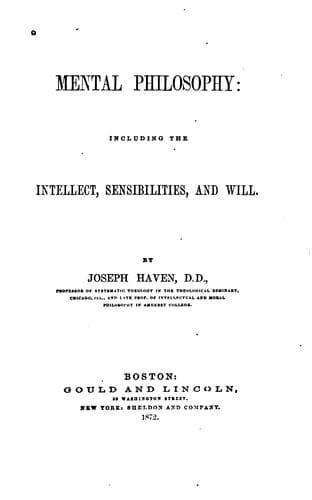
Mental Philosophy: Including the Intellect, Sensibilities, and WillHaven, Joseph
Philosophy
Mental Philosophy: Including the Intellect, Sensibilities, and Will
Haven, Joseph
Psychology
_Objection to Stewart's Division._--The arrangement of Mr. Stewart
is liable to this objection, that the principle of self-love, and
also the moral faculty, which he classes by themselves as _rational_
principles, in distinction from the other emotions as _implanted_ or
_instinctive_ principles, are as really implanted in our nature, as
really constitutional or instinctive, as any other. Appetite, moreover,
is but one form or class of desires; self-love is but another, _i. e._,
the desire of our own happiness.
_To Upham's Division._--The division of Mr. Upham is still more
objectionable on the same ground. The _natural_ and the _moral_
sentiments, into which two great classes he divides the sensibilities,
are distinct neither in fact nor in name; the moral sentiments, so
called, are as really and truly _natural_, founded in our constitution,
as are our desires and affections; nor is the term natural properly
opposed to the term moral as designating distinct and opposite things.
The terms instinctive and rational, which Mr. Stewart employs, though
not free from objection, much more accurately express the distinction
in view, could such a distinction be shown to exist.
_Difference of ethical and psychological Inquiry._--In a work, the
main object of which is to unfold the principles of ethical science,
it may be desirable to single out from the other emotions, and place
by themselves, the principle of self-love, together with the social
principle and the moral sentiments, as having more direct reference to
the moral character and conduct. In a strictly psychological treatise,
however, in which the aim is simply to unfold, and arrange in their
natural order, the phenomena of the human mind, such a principle of
classification is evidently inadmissible. The different operations
and emotions of the mind must be studied and arranged, not with
reference to their _logical_ or _ethical_ distinctions, but solely
their _psychological_ differences. Viewed in this light, the moral
sentiments, so far as they are of the nature of feeling or sensibility
at all, and not rather of intellectual perception, are simple emotions,
and do not inherently differ from any other feelings of the same
class. The satisfaction we feel in view of right, and the pain in view
of wrong past conduct, differ from the pain and pleasure we derive
from other sources, only as the _objects_ differ which call forth the
feelings. They are essentially of the same class, the difference is
specific rather than generic. They are modifications of the one generic
principle of joy and sorrow, and differ from each other not so much as
each differs from a _desire_, or an affection of love or hate.
Public-domain text, read in full here on John Shaqi.
Reviews
Reviews
No reviews yet
Be the first to share your thoughts on this work.
Elsewhere in the archive
Join the Discussion
Join the discussion
Sign in to leave a comment or review.
Sign InorCreate an account