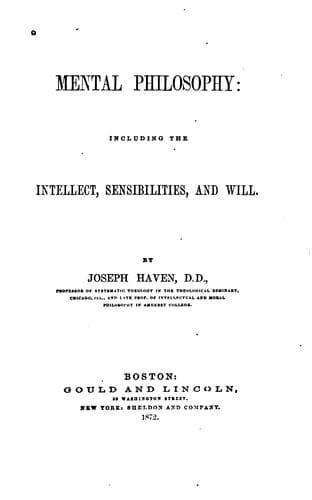
Mental Philosophy: Including the Intellect, Sensibilities, and WillHaven, Joseph
Philosophy
Mental Philosophy: Including the Intellect, Sensibilities, and Will
Haven, Joseph
Psychology
_Objection to Brown's Arrangement._--The classification of Dr. Brown,
if not ethical, is, perhaps, equally far from being psychological. The
relation of the different emotions to _time_ is an accidental, and not
an essential difference, and it is, moreover, a distinction wholly
inapplicable to far the larger portion of the sensibilities, viz.,
those which he calls immediate emotions, or "those which arise without
involving necessarily _any notion_ of time." This is surely _lucus a
non lucendo_.
SENSIBILITIES.
PART FIRST.
SIMPLE EMOTIONS.
CHAPTER I.
INSTINCTIVE EMOTIONS.
_Previous Analysis._--It will be recollected that in the analysis which
has been given of the sensibilities, they were arranged under three
generic classes, viz., Simple Emotions, Affections, and Desires, all,
however, having this in common, that they are in themselves agreeable
or disagreeable, as states of mind, according as the object which
awakens them is viewed as either good or evil.
_Nature of simple Emotions._--Of these, the _simple emotions_, which
are first to be considered, comprise, it will be remembered, that large
class of feelings which, in their various modifications and degrees,
constitute the joys and sorrows of life. They may be comprised, with
some latitude of meaning, under the general terms joy and sorrow,
as modifications of that comprehensive principle or phase of human
experience. They are awakened in view of an object regarded as good
or as evil; an object, moreover, of present possession and present
enjoyment or suffering; in which last respect they differ from
_desires_, which have respect always to some good, or apparent good,
_not_ in present possession, but viewed as attainable.
_Division of simple Emotions._--Of these simple emotions, again, some
may be called _instinctive_, as belonging to the _animal_ nature, and,
to some extent, common to man with the brutes, in distinction from
others of a higher order, involving or presupposing the exercise of
reason and the reflective powers.
It is of the former class that we are to treat in the present chapter.
§ I.--OF THAT GENERAL STATE OF THE MIND KNOWN AS CHEERFULNESS; AND ITS
OPPOSITE, MELANCHOLY.
_Nature of this Feeling._--There is a state of mind, of which every
one is at times conscious, in which, without any immediately exciting
cause, a general liveliness and joyousness of spirit, seldom rising
to the definiteness of a distinct emotion, a subdued under-current of
gladness, seems to fill the soul, and flow on through all its channels.
It is not so much itself joy, as a disposition to be joyful; not so
much itself a visible sun in the heavens, as a mild, gently-diffused
light filling the sky, and bathing all objects in its serene loveliness
and beauty. It has been well termed "a sort of perpetual gladness."
Public-domain text, read in full here on John Shaqi.
Reviews
Reviews
No reviews yet
Be the first to share your thoughts on this work.
Elsewhere in the archive
Join the Discussion
Join the discussion
Sign in to leave a comment or review.
Sign InorCreate an account