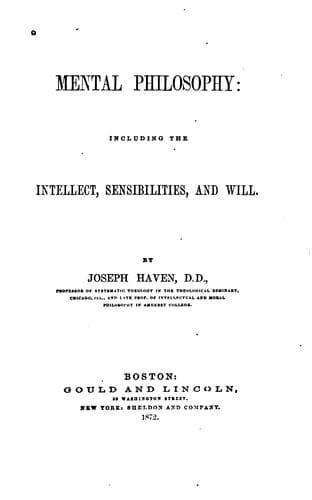
Mental Philosophy: Including the Intellect, Sensibilities, and WillHaven, Joseph
Philosophy
Mental Philosophy: Including the Intellect, Sensibilities, and Will
Haven, Joseph
Psychology
_Prevalence at different Periods of Life._--There are those, of
fortunate temperament, with whom this seems to be the prevailing
disposition, to whom every thing wears a cheerful and sunny aspect. Of
others, the reverse is true. In early life this habitual joyousness
of spirit is more commonly prevalent; in advanced years, more rarely
met with. Whether it be that age has chilled the blood, or that the
sober experience of life has saddened the heart, and corrected the
more romantic visions of earlier years, as life passes on we are less
habitually under the influence of this disposition. It is no longer the
prevailing frame of the mind. In the beautiful language of another,
"We are not happy, without knowing why we are happy, and though we may
still be susceptible of joy, perhaps as intense, or even more intense,
than in our years of unreflecting merriment, our joy must arise from
a cause of corresponding importance; yet even down to the close of
extreme old age there still recur occasionally some gleams of this
almost instinctive happiness, like a vision of other years, or like
those brilliant and unexpected corruscations which sometimes flash
along the midnight of a wintry sky, and of which we are too ignorant
of the circumstances that produce them, to know when to predict their
return."
_The opposite Feeling._--Corresponding to this general state of mind
now described, is one of quite the opposite character--that habitual
disposition to sadness which is usually called melancholy. Like its
opposite, cheerfulness, it is rather a frame of mind than a positive
emotion, and, like its opposite, it exists, often, without any marked
and definite cause to which we can attribute it. It is that state in
which subsiding grief, or the pressure of any severe calamity now
passing away, leaves the mind, the grey and solemn twilight that
succeeds a partial or total eclipse. It is, with many persons, the
habitual state of mind, through long periods, perhaps even the greater
part, of life. Not unfrequently it occurs that minds, of the rarest
genius and most delicate sensibility, are subject to that extreme
and habitual depression of spirits which casts a deep gloom over the
brightest objects, and renders life itself a burden. This state of
habitual gloom and despondency, itself usually a form of disease, the
result of some physical derangement, deepens sometimes into a fixed
and permanent disorder of the mind, and constitutes one of the most
pitiable and hopeless forms of insanity. Such was the case with the
melancholy, but most amiable and gentle Cowper.
Public-domain text, read in full here on John Shaqi.
Reviews
Reviews
No reviews yet
Be the first to share your thoughts on this work.
Elsewhere in the archive
Join the Discussion
Join the discussion
Sign in to leave a comment or review.
Sign InorCreate an account