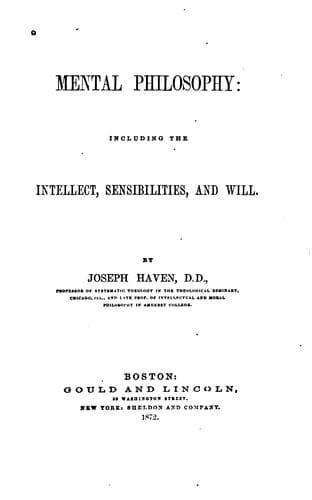
Mental Philosophy: Including the Intellect, Sensibilities, and WillHaven, Joseph
Philosophy
Mental Philosophy: Including the Intellect, Sensibilities, and Will
Haven, Joseph
Psychology
_Element of poetic Sensibility._--In its milder forms, the state of
mind which I describe, constitutes, not unfrequently, an element of
what is termed poetic genius, a melancholy arising from some sad
experience of the troubles and conflicts of life, and from sympathy
with the suffering and sorrowing world, the great sad heart of
humanity--a melancholy that, like the plaint of the Æolian harp, lends
sweetness and richness to the music of its strain. Such are many
of the strains of Tennyson; such the deep under-current of Milton's
poetry; such, preëminently, the spirit and tone of John Foster, one
of the truest and noblest specimens of poetic genius, although a
writer of prose. A quick and lively sensibility, itself an inseparable
concomitant of true genius, is not unfrequently accompanied with this
gentler form of melancholy. The truly great soul that communes with
itself, with nature, and with eternal truth, is no stranger to this
subdued yet pleasing sadness. It is this to which Milton pays beautiful
tribute in the _Il Penseroso_, and which he thus invokes:
"But hail, thou goddess, sage and holy,
Hail, divinest Melancholy!
Come, pensive nun, devout and pure,
Sober, steadfast, and demure,
All in a robe of darkest grain
Flowing with majestic train,
And sable stole of Cyprus lawn
Over thy decent shoulders drawn.
Come, but keep thy wonted state,
With even step and musing gait,
And looks commercing with the skies,
Thy rapt soul sitting in thine eyes."
_Not inconsistent with Wit._--It should be remarked that the
disposition of which we speak is not inconsistent with the occasional
and even frequent prevalence of feelings of directly the opposite
nature. A prevailing tendency to sadness is not unfrequently
associated with an almost equally prevailing tendency to emotions
of the ludicrous. The same liveliness of sensibility which prepares
the soul to feel keenly whatever in life is adapted to awaken sad
and sober reflections, also disposes it to notice quickly the little
incongruities of character, the foibles and follies of mankind, in
which a duller eye would detect nothing absurd or comical. It is,
moreover, the natural tendency of the mind to spring back, like the
bow unstrung, from one extreme of feeling to its opposite, and seek
relief from its sadness in the lighter sallies of wit. And so we have
the melancholy Cowper singing John Gilpin, and the author of the Night
Thoughts, in conversation, a jovial and witty man.
§ II.--SORROW AT LOSS OF FRIENDS.
Public-domain text, read in full here on John Shaqi.
Reviews
Reviews
No reviews yet
Be the first to share your thoughts on this work.
Elsewhere in the archive
Join the Discussion
Join the discussion
Sign in to leave a comment or review.
Sign InorCreate an account