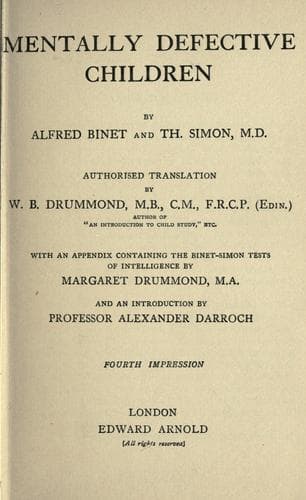
Children with mental disabilities -- Education; Children with mental disabilities -- Psychological testing
complicated, and adaptation is more easy, than in the towns. There is
a certain, practical, even easy way of finding out whether the teacher
has been trying to keep in contact with real life, and whether his
school for defectives is well managed. It is to find out what becomes
of the defectives on leaving school, and what percentage he has been
able to place in situations with a suitable salary.
Such measures of control are so logical that they only require to be
formulated to obtain the immediate assent of all sensible minds. Yet
one may ask whether, as a matter of fact, in the schools managed by
the State, the inspectors occupy themselves sufficiently with this
practical side of education, and do not even make the mistake of
judging the education by itself, according to a conventional,
literary, or scientific ideal. We are not speaking of public schools,
colleges, and lycées. These establishments are attended by normal
children, and it may be admitted that it is not, strictly speaking,
the business of the State to prepare these for social life. As a
matter of fact, that is not our own opinion, but that does not matter.
What is certain is that the duty of the State becomes more precise and
more pressing when it is a question of assuring the lot of the
defectives. Has it always been kept in mind that their education
should put them in the way of an occupation, and that one should teach
them nothing useless, so as not to make them lose their time? We do
not think so. We hope that the schools for the blind take care to know
whether the Braille which they teach their pupils is a method of
reading and writing which will be useful to them in life; whether the
manual arts, such as caning chairs, the making of brushes and
mattresses, are the best means which they can teach to the
non-musicians whereby to gain their bread. We equally hope that in the
schools for the deaf and dumb, which are teaching their pupils by the
oral method--with what effort, what expense, and what devotion one may
imagine--they have inquired what percentage of their pupils attained
the ability to communicate verbally with people other than their
teachers, and also what is the percentage of pupils who, ten years
after leaving school, still use that method and find it advantageous.
All these questions should be asked, and conscientious minds should
try to find an answer to them by impartial inquiry, in order to find
out whether the methods are useful, and whether the school is
directing its energies well. What is being done about this with
respect to the schools for defectives?
We must do this justice to the legislation at present projected with
regard to defectives, that it is not indifferent with regard to this
question of control. The Ministerial Commission, in which one of us
took part, heard many demands for guarantees of this kind. Its
mistrust was awakened, and it made a number of suggestions which have
been included in the Bill.
Public-domain text, read in full here on John Shaqi.
Reviews
Reviews
No reviews yet
Be the first to share your thoughts on this work.
Elsewhere in the archive
Join the Discussion
Join the discussion
Sign in to leave a comment or review.
Sign InorCreate an account