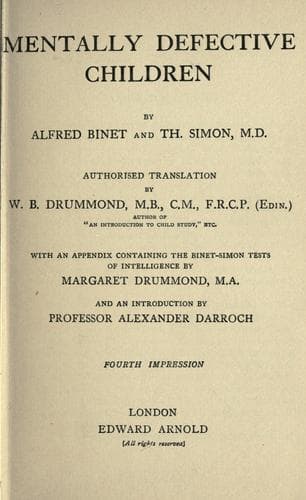
Children with mental disabilities -- Education; Children with mental disabilities -- Psychological testing
Thus, an elementary school inspector is trusted with the duty of
taking account of the educational progress of each child. A little
book must be kept recording full particulars of each individual case.
The principle of supervision by a Care Committee after leaving school
has been adopted. All this is excellent. The law cannot enter into
minute details. Administrative rules must be drawn up to provide
against the two causes of error, prejudice and negligence.
Let us consider this question from our own point of view, and
distinguish clearly between the educational and the social return.
=The Educational Return of the Special Schools and Classes.=--In the
first place, in order to gauge the advantages of special education, it
is necessary to find out what becomes of defectives when they are left
in the ordinary schools. It is quite clear that special education
should be condemned and suppressed if it does not do more than the
ordinary schools. We have seen that, in the latter, the defective is a
dead weight, and the ill-balanced is a nuisance. Nevertheless, one
must not jump to the conclusion that these children are in no wise
modified by the school influences, and do not profit in any degree by
the instruction. We have already pointed out some very touching facts:
a little defective girl has learned to read, thanks to the persevering
help of one of her normal companions. This proves, at least, that
association with normal children may be good for something, but let us
leave such anecdotes and attempt to reach a comprehensive view of the
situation.
We have been able to collect in the primary schools of Paris, thanks
to the kind assistance of M. Belot, particulars which are very
valuable, though restricted in amount. These particulars we have
examined in every possible way, and we always reach the same
conclusion: _the defective makes very slow progress in the ordinary
schools_.
Let us consider, for example, _en bloc_, forty-five defectives of
whom we possess records, and see to what extent they are behind at
different ages. We get the following table:
Age. Retardation.
7 2 years }
8 2 " } about 2 years.
9 1-½ " }
10 3 " }
11 3-½ " } about 3 years.
12 3 " }
13 3-½ " }
14 6 " }
15 5 " } about 5 years.
Public-domain text, read in full here on John Shaqi.
Reviews
Reviews
No reviews yet
Be the first to share your thoughts on this work.
Elsewhere in the archive
Join the Discussion
Join the discussion
Sign in to leave a comment or review.
Sign InorCreate an account