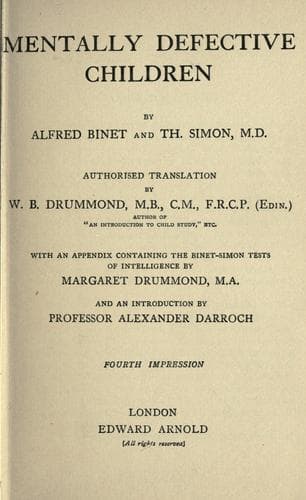
Children with mental disabilities -- Education; Children with mental disabilities -- Psychological testing
Now for the educational consequences of the preceding theory. If the
backwardness is only a slowness of development, it will suffice to
apply to the backward the same methods as to the normal. One will make
them follow the same course of study and go just as far as possible.
Every defective must work towards the primary school certificate. To
attain that end, he ought to pass through seven regular stages, one
each year. The teacher of defectives cannot hope that he will bring
his pupils to the last stage. He will stop half-way. One day, at the
agricultural colony of Vaucluse, when some foreign doctors were
visiting the establishment, the teacher showing his class to the
visitors remarked with naïve pride: "Our pupils follow step by step
the curriculum of the primary school."
A second and totally different theory is tenable, and this one appears
to us to be much nearer the truth. It is that a defective child does
not resemble in any way a normal one whose development has been
retarded or arrested. He is inferior, not in degree, but in kind. The
retardation of his development has not been uniform. Obstructed in one
direction, his development has progressed in others. To some extent he
has cultivated substitutes for what is lacking. Consequently such a
child is not strictly comparable to a normal child younger than
himself. So far as certain faculties are concerned, he remains at the
level of a younger child; but in respect to others, he is on a level
with normal children of his own age. An unequal and imperfect
development is consequently his specific characteristic. These
inequalities of development may vary to any degree in different
subjects. They always produce a want of equilibrium, and this want is
the differentiating attribute of the defective child. But to draw a
faithful picture we must add yet other traits. According to general
opinion, mental deficiency is a disease, and although the idea of
disease is very vague, we are inclined to fall in with this general
opinion. In the first place, we frequently find in such children
defects of speech. Besides, in studying their mental condition more
closely, one finds in some cases peculiarities of understanding,
reasoning, imagining, difficult to define, but which do not appear to
have their equivalent in younger normal children, and which therefore
do not result from simple retardation of development. Here is a boy,
twelve years of ago, who tries to answer our questions, and succeeds
pretty well; but hardly has he finished his answer when he deserts the
subject altogether and begins to talk a lot of nonsense. This want of
coordination in thought constitutes a special defect, and not a
retardation of development. Possibly one would not find analogous
features in other backward children, who tend rather to be laconic;
but it is also possible that a careful analysis of their mental state
might reveal in them other mental symptoms, and, indeed, such are very
Public-domain text, read in full here on John Shaqi.
Reviews
Reviews
No reviews yet
Be the first to share your thoughts on this work.
Join the Discussion
Join the discussion
Sign in to leave a comment or review.
Sign InorCreate an account