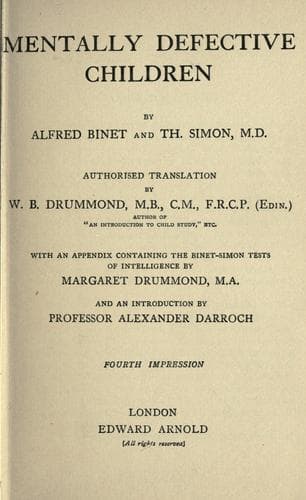
Children with mental disabilities -- Education; Children with mental disabilities -- Psychological testing
obvious in the variety called "unstable" or "ill-balanced."
To sum up, we are of opinion that the defective child usually exhibits
the following characters: (1) A retardation of development; (2) a
defect of equilibrium--_i.e._, the retardation is more marked in some
faculties than in others; (3) individual peculiarities of a
pathological kind in the mental powers.
If this second theory is correct, there follows a very important
practical consequence--namely, that the curriculum drawn up for normal
children is very imperfectly suited to the defective. We cannot force
the latter to fit the ordinary course. To attempt this would be quite
as unreasonable as to make our teaching appeal to the ears of the deaf
or the eyes of the blind.
The first duty of the teacher is to take account of the faculties
already developed, the aptitudes which are already apparent. His work
is thankless and difficult; he would be foolish not to take advantage
of the indications of nature. If a pupil show a special taste for any
subject, it is evidently towards such a line of study that he should
be directed. Consequently, in conformity with these ideas, we would
reject on principle any programme of special instruction which would
rigorously include all the children in a common plan. On the contrary,
we would prefer for the defective a scheme which would take the most
account of their natural aptitudes.
Such considerations lead us to put the following question--What are
the most common aptitudes in children of this class? We say "the most
common," because we have not to do with a single well-defined type,
for there are as many varieties as there are individuals; but in spite
of the number of those varieties, which shows the need for individual
teaching, it will always be possible to establish categories in which
those most nearly alike may be grouped It is also possible that the
aptitudes most frequently lacking are always, or almost always, of the
same nature.
To solve the question which we have just raised, we shall employ two
methods--
_The questionnaire._
_Direct observation._
A printed questionnaire containing thirty-eight questions has been
distributed through the agency of M. Belot, school inspector, to the
heads of all the elementary schools in two districts of Paris--one
central, the other suburban. Nothing would be gained by reproducing
here the questionnaire, which has served its purpose. We shall simply
lay down the conclusions we have reached, after studying the replies
with the greatest care.
Public-domain text, read in full here on John Shaqi.
Reviews
Reviews
No reviews yet
Be the first to share your thoughts on this work.
Join the Discussion
Join the discussion
Sign in to leave a comment or review.
Sign InorCreate an account