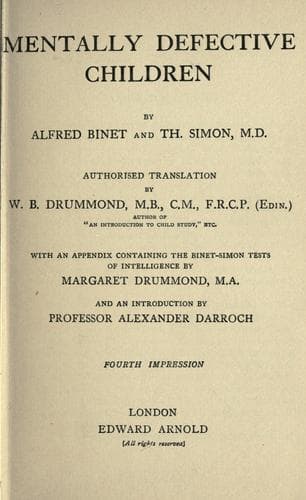
Children with mental disabilities -- Education; Children with mental disabilities -- Psychological testing
_Eugenie_, by tossing her head. She mimics her teacher, and
makes the others laugh, so that they have to hide their faces.
_Octavia_ replies, "What do I care!" She bursts out laughing and
continues to do what she has been forbidden.
_Leontine_ quibbles, answers back, and expresses aloud her bad
humour.
_Raoul_ flies into a passion when he is reprimanded. He poses as
a martyr, a victim of injustice, and sometimes even utters
threats. Punishment makes him give vent to intemperate language.
_Victor_ assumes an attitude of revolt, turns pale, and refuses
to obey when anyone checks him.
_Lucy_ broke her pen in a fit of temper.
_Helen_ in the same circumstances upsets everything in her
neighbourhood.
_Louise_ strikes her elbows on the desk, and one day she even
kicked her teacher.
_Leon_ is quarrelsome and his companions are afraid of him.
_George_ does nothing but tease his companions. He destroys
their copybooks, tears pages from their books, and puts the
blame on them.
_Charles_, who is rendered obstinate by strictness and merely
irritated by punishment, seems happy when one takes an interest
in him.
_Eugenie_, who is greatly excited by punishment and who smiles
at rewards, loves to be flattered and picked out to do some
little service.
The three following traits are constantly met with in the descriptions
of the ill-balanced: they are turbulent, boastful, and incapable of
attention. To this may be reduced the psychology of the less strongly
marked cases. They have an instability of body, of speech, of
attention, which may result either from an excessively nervous
disposition, or simply from a nature whose restlessness rebels against
sedentary and silent study. But in many cases other features are
present. In addition to the preceding symptoms, there are found
impatience of discipline and a tendency to annoy their comrades. The
ill-balanced are spoken of as brutal, deceitful, cruel; and as to
their obstinacy, the abundant details in the questionnaires show that
these children have left a disagreeable impression on the school
staff. It is especially on their account that an outcry for special
schools has arisen. The way in which these children react to
discipline is very interesting. We are told that they are very little
influenced by rewards, which they often receive with disdain,
laughter, or irony, if they do not refuse them altogether.
Punishments, on the other hand, produce a bad effect. The ill-balanced
nearly always become angry, and rebel against punishment, so that the
teachers strive to avoid coming into conflict with them. Here we have
a trait which is very interesting for psychology, but very
embarrassing for pedagogy. How, then, can the ill-balanced be
subjected to any discipline whatever? This is an important question,
which it will be all the more necessary to solve because it is the
Public-domain text, read in full here on John Shaqi.
Reviews
Reviews
No reviews yet
Be the first to share your thoughts on this work.
Join the Discussion
Join the discussion
Sign in to leave a comment or review.
Sign InorCreate an account