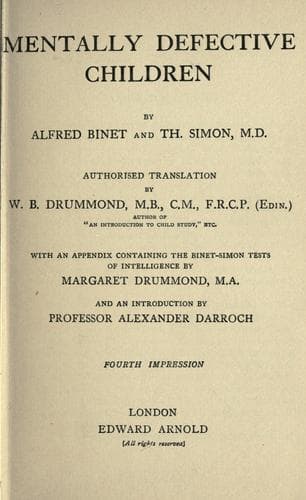
Children with mental disabilities -- Education; Children with mental disabilities -- Psychological testing
ill-balanced who profit most by special education; it is for them that
one would have most hope. Our advice is that, in order to control
these children, account should be taken, in the first place, of their
dominant tendency. The study of the answers to the questionnaires
shows us that the chief thing to which one can appeal in these cases
is their amour-propre, their pride, their vanity--in a word, the whole
range of the egoistic sentiments. On natures of this stamp punishment
cannot have much effect, seeing that it is opposed by an often
indomitable pride. The end may be reached more directly, not by
breaking the resistance, but by giving it a different direction. It is
better to praise the ill-balanced when he has done well than to punish
him for his faults. It is desirable also to show him some
appreciation, or even to trust him with some duty of a very modest
kind, which he may perform under discreet supervision.
=Mental Aptitudes of the Defective.=--Having briefly sketched the
moral aptitudes of the abnormal, let us now examine their mental
aptitudes. We have here a very captivating subject of inquiry. The
study of individual aptitudes ought to have been undertaken long ago
in the interest of education. Everyone is crying out for it. No one,
or almost no one, undertakes it. In the case of the abnormal there is
even more urgent need that it should be undertaken, for the younger or
less intelligent the pupils, the more depends upon educational
methods. When a mind is of a superior kind, very little really depends
upon the culture supplied to it. If a Berthelot or a Pasteur should
even have had imbeciles as their first masters in chemistry, they
would none the less have turned out men of genius. It is those of
average intelligence who have need of good methods of instruction. It
is the young children who really require intelligent methods.
Consequently we should give the defectives the best teachers. Every
fault of method committed in their education may have consequences
which will prejudice them later on.
Public-domain text, read in full here on John Shaqi.
Reviews
Reviews
No reviews yet
Be the first to share your thoughts on this work.
Join the Discussion
Join the discussion
Sign in to leave a comment or review.
Sign InorCreate an account