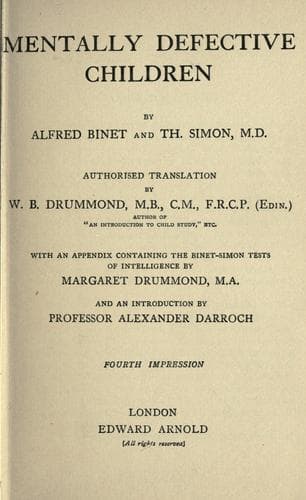
Children with mental disabilities -- Education; Children with mental disabilities -- Psychological testing
(1) The results of the rupture of a cerebral vessel--_e.g._, from
asphyxia at birth or a delivery by forceps. Blood has been poured out
into the nervous tissue. The latter has been destroyed over a greater
or less extent, and there is found in its place a cyst filled with
sero-sanguineous fluid.
(2) The obstruction of an artery--_e.g._, by septic thrombosis--has
prevented the blood from reaching a part of the brain, with similar
results to those mentioned.
(3) In other cases are found the more or less extensive changes
produced by meningitis or meningo-encephalitis. The inflammation of
its envelopes has interfered with the brain, and consequently with its
functions.
(4) An increased secretion of cerebro-spinal fluid has led to a
compression of the nervous system or a distension of its cavities,
notably of the lateral ventricles of the cerebral hemispheres, and has
led to a separation of the bones of the cranium, thus producing the
large globular head of hydrocephalus.
(5) There may be found simply defects of development whose causes are
known (microcephalus, or extreme smallness of the cranium relatively
to the face; microgyria, or marked thinness of the convolutions).
(6) Lastly--and this is frequently the case in the worst degrees of
deficiency--the post-mortem, and even microscopic examination of the
organs may show no change at all.
Let us add that the nature of the lesions just mentioned does not seem
to have any relationship to the condition of the mental faculties. An
anatomico-pathological grouping of the cases and a grouping according
to the mental condition, far from being parallel, are frequently
decidedly different. On the other hand, the extent of the lesions is
of more importance. Diffuse lesions affect the mind more than those
which are circumscribed--that is to say, limited to a certain part of
the brain--as if the mental functions required the co-operation of the
entire cerebral cortex. One will often find, for example, sound
judgment in the subject of a marked paralysis, whilst it is very rare
to find that good intelligence co-exists with any degree of
microcephalus.
Let us emphasise the last fact we mentioned, the absence of any
lesion. Some authorities have maintained that all conditions of mental
deficiency and want of balance found in children are connected with
definite diseases of which they are the symptoms. The question is
unsettled. For our own part we adopt the following provisional
statement: Mental deficiency and want of balance are peculiar mental
conditions which it is often impossible to connect with definite
pathological changes.
Thus, we do not know of any medical treatment which is likely to act
upon the preceding lesions when they are present, and we do not think
it is even possible to act upon them.
Public-domain text, read in full here on John Shaqi.
Reviews
Reviews
No reviews yet
Be the first to share your thoughts on this work.
Elsewhere in the archive
Join the Discussion
Join the discussion
Sign in to leave a comment or review.
Sign InorCreate an account