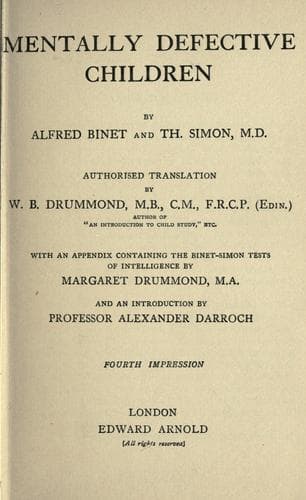
Children with mental disabilities -- Education; Children with mental disabilities -- Psychological testing
An exception must, however, be made of conditions due to insufficient
secretion of certain glands. The type of these is cretinism. Marked
cases of this condition are easy to recognise. The very appearance of
the children is sufficient for an experienced eye--the stunted growth;
the rough, wrinkled skin; the swollen eyelids half-concealing the
eyes; the prominent belly; and the mental apathy. One also comes
across abortive cases, where the above-mentioned characters are less
marked; the sluggishness also is less. These latter cases are amenable
to the same treatment as the former--namely, the ingestion of thyroid
glands from the sheep.
This treatment stimulates growth and makes the child more lively; but
what ultimately becomes of the cases so treated? The amelioration
usually ceases whenever the treatment is dropped. But how far does
this amelioration go? To what extent does the child profit by it?
Lasègue has jocularly remarked that the average duration of an attack
of typhoid fever (six weeks) represents the maximum time during which
medical attention could be brought to bear upon a patient. One feels
disposed to think he is right in face of the slight satisfaction one
can obtain from the literature regarding a point of such importance.
Other cases of mental deficiency may be due to an alteration in the
pituitary gland. It is for the doctor to find out whether there are
any symptoms by which mental deficiency of such an origin can be
recognised, and whether it is possible to prepare a suitable substance
for replacing the absent secretion.
The number of cases amenable to treatment of this kind is,
unfortunately, very limited.[13] We may even say that, as a general
rule, we did not find amongst the school children we examined any
cases of obesity or infantilism such as are sometimes described of a
truly remarkable nature. Even children who were abnormally short
looked their age. We have still, however, to mention one last
influence--namely, poverty. Its part in the production of mental
debility is scarcely defined. What are the exact effects upon
intelligence of prolonged deficiency of nutrition? How can its action
be isolated from that of other agents, such as alcoholism, which too
frequently accompanies it? The complexity of such social studies
sufficiently explains their present incompleteness. Let us recall the
results we obtained from an inquiry of this kind; the children of
parents in extreme poverty are retarded in their physical development
more frequently than those whose parents are in easy circumstances. It
is interesting to add that analogous inquiries with reference to
intelligence have furnished similar results.
Public-domain text, read in full here on John Shaqi.
Reviews
Reviews
No reviews yet
Be the first to share your thoughts on this work.
Elsewhere in the archive
Join the Discussion
Join the discussion
Sign in to leave a comment or review.
Sign InorCreate an account