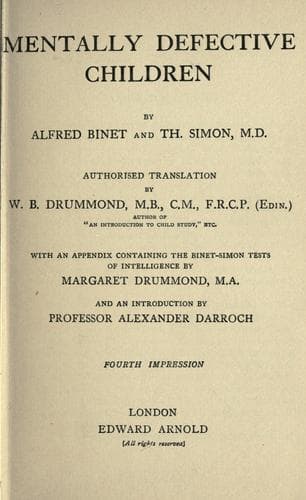
Children with mental disabilities -- Education; Children with mental disabilities -- Psychological testing
Apart from the preceding cases, the best that can be done is to treat
the symptoms. The two principal agents at the disposal of the doctor
are the bromides and hydrotherapy. Unfortunately, if the bromides are
undoubtedly efficacious in certain cases of epilepsy, that is far from
being the case in simple want of mental balance, in which cases they
are at best useful adjuvants. As to hydrotherapy, and especially cold
douches, their principal indication is in certain nervous affections,
where their effect is to enable the subject to master the emotional
reactions which are habitually exaggerated.
Lastly, the doctor can exert his moral influence to assist the
educative work of the teacher in the special school. His less frequent
intervention, the different motives of his advice, will often give him
even more authority than the teacher. The suggestive effects of his
intervention should be obtained, in our opinion, without resort to
hypnotism.
=3. Does the Mentally Defective suffer from any Definite Illness?=--If
the illness such as we have referred to affects those parts of the
cerebral cortex which govern the muscles of a limb, one will find, in
addition to the mental condition, paralysis with atrophy and
contracture. But in addition to such very marked cases, there exist
others in which sensory or motor affections, although slight, may
hinder the progress of education.
It goes without saying that if a child does not profit from the school
work, an examination of his sight and hearing should be made as a
matter of course. Perhaps that may have been done already by the
teacher himself by such methods as he is able to use. But this first
examination is not sufficient. The doctor must correct, as far as
possible, the want of acuity noticed. No doubt the defect may not
explain the mental deficiency of the child, but one must take care
that in the school for defectives a pronounced myopia or catarrh of
the middle ear does not prove an obstacle to the efforts which are to
be made to bring about development.
In the same way it must be considered whether the condition of the
muscular system is such as to permit the manual work which one wants
to teach the child, and whether there exists any paralysis or tremor
which would prove an obstacle to work of this kind. One must consider
whether any symptoms present are transitory, like chorea; or
permanent, like infantile hemiplegia; and what kind of efforts may be
made without risk to the health of the child. Such are the problems
which the doctor has to solve.
* * * * *
In the last place, it is necessary to take into account the
coexistence with the mental deficiency of other affections.
Public-domain text, read in full here on John Shaqi.
Reviews
Reviews
No reviews yet
Be the first to share your thoughts on this work.
Elsewhere in the archive
Join the Discussion
Join the discussion
Sign in to leave a comment or review.
Sign InorCreate an account