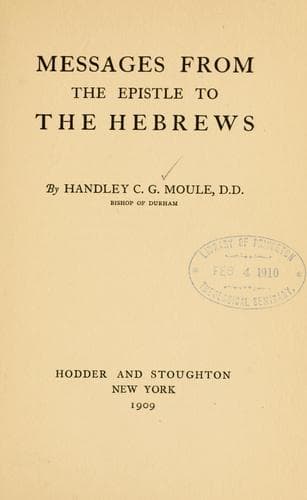
Messages from the Epistle to the HebrewsMoule, H. C. G. (Handley Carr Glyn)
Religion
Messages from the Epistle to the Hebrews
Moule, H. C. G. (Handley Carr Glyn)
Bible. Hebrews -- Commentaries
But then further, does this passage really intimate at all that He is
offering now? The thought appears to be decisively negatived by the
grandeur of the terms of the first verse of this chapter. Where, in the
heavenly sanctuary, is our High Priest now? He has "taken His seat on
the right hand of the throne of the majesty." But enthronement is a
thought out of line with the act and attitude of oblation. The offerer
stands before the Power he approaches. Our Priest is seated--where Deity
alone can sit.
Does not this tell us that the words (ver. 3), "It is necessary that He
too should have something to offer," are to be explained not of a
continuous historical procedure (to which idea, by the way, the aorist
verb [Greek: prosenenke] would hardly be appropriate), but as the
statement of a principle in terms of time? The "necessity" is, not that
He should have something to offer now, and to-morrow, and always, but
that the matter and act of offering should belong to Him. And they do so
belong, in principle and effect, for priestly purposes, by having been
once and for ever handled and performed by Him. His "need" is, not to be
always offering, but to be always an Offerer. He meets that need by
being for ever the Priest who had Himself to offer, and who offered
Himself, and who now dispenses from His sacerdotal seat the benedictions
based upon the sacrifice of which He is for ever the once accepted
Offerer.
Only thus viewed, I venture to say, can this phrase be read in its full
harmony with the whole Epistle. "He hath somewhat to offer," in the
sense that He has for ever the grand sacerdotal qualification of being
an Offerer who, having executed that function, now bears to all eternity
its _character_. But He is not therefore always executing the function.
Otherwise He must descend from His throne. But His enthronement, His
session, is a fact of His present position as important and
characteristic as possible in this whole Epistle.
Aaron was not always offering. But he was always an offerer. On the
morrow of the Atonement Day he was as much an offerer as on the day
itself. All through the year, even until the next Atonement, he was
still an offerer. He exercised his priestly functions at all times
because, in principle, he "had somewhat to offer" in its proper time.
_Our_ High Priest knows only one Atonement Day, and it is over for ever.
And His Israel have it for their privilege and glory not to be "serving
unto an example and shadow" of even His work and office, but to be going
always, daily and hourly, direct to Him in His perfect Priesthood, in
which they always "have" Him, and to be always abiding, in virtue of
Him, "boldly," "with confidence," in the very presence of the Lord.
Public-domain text, read in full here on John Shaqi.
Reviews
Reviews
No reviews yet
Be the first to share your thoughts on this work.
Join the Discussion
Join the discussion
Sign in to leave a comment or review.
Sign InorCreate an account