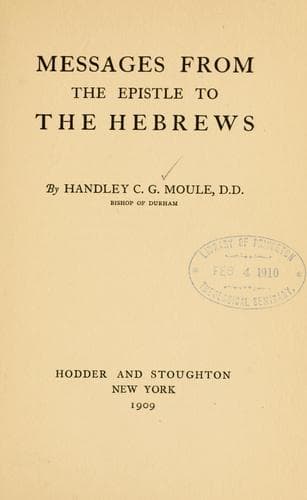
Messages from the Epistle to the HebrewsMoule, H. C. G. (Handley Carr Glyn)
Religion
Messages from the Epistle to the Hebrews
Moule, H. C. G. (Handley Carr Glyn)
Bible. Hebrews -- Commentaries
Then the chapter moves forward (verses 6 and following) to consider the
relation between our High Priest and _the Covenant_ of which He is the
Mediator. Here begins one of the great themes of the Epistle. It will
recur again and again, till at last we read (xiii. 20) of "the blood of
the Covenant eternal."
This pregnant subject is introduced by a solemn reference to the
"promises upon which has been legislated," legally instituted, [Greek:
nenomothetetai], this new compact between God and man. The reference is
to the thirtieth chapter of Jeremiah, from which an extract is here made
at length. There the prophet, in the name of his God, explicitly
foretells the advent of what we may reverently call a new departure in
the revealed relations between Jehovah and His people. At Sinai He had
engaged to bless them, yet under conditions which left them to discover
the total inability of their own sin-stricken wills to meet His holy
while benignant will. They failed, they broke the pact, and judgment
followed them of course. But now another order is to be taken. Their
King and Lawgiver, without for one moment ceasing to be such, will also
undertake another function, wholly new, as regards the method of
covenant. He will place Himself so upon their side as Himself to
readjust and empower their affections and their wills. He "will put His
laws into their mind and write them upon their hearts," and "they shall
all know Him," with the knowledge which is life eternal. And further, as
the antecedent to all this, in order to open the path to it, to place
them where this wonderful blessing can rightly reach and fill them,
their King and Lawgiver pledges Himself to a _previous_ pardon, full and
unreserved; "Their sins and their iniquities I will remember no more."
They shall be set before Him in an acceptance as full as if they had
never fallen. And then, not as the condition to this but as the sequel
to it, He will so deal with them, internally and spiritually, that they
shall will His will and live His law. There shall be no mechanical
compulsion; "their mind," "their hearts," full as ever of personality
and volition, shall be the matter acted upon. But there shall be a
gracious and prevailing influence, deciding their spiritual action along
its one true line; "I will put," "I will write."
This is the new, the better, the everlasting Covenant. It is placed here
in the largest and most decisive contrast over against the old covenant,
the compact of Sinai, "written and engraven in stones" (2 Cor. iii. 7).
That compact had done its mysterious work, in convincing man of his
sinful incapacity to meet the will of God. Now emerges its wonderful
antithesis, in which man is first entirely pardoned, with a pardon which
means acceptance, peace, re-instatement into the home and family of God,
and then and therefore is internally transfigured by his Father's power
into a being who loves his Father's law.
Public-domain text, read in full here on John Shaqi.
Reviews
Reviews
No reviews yet
Be the first to share your thoughts on this work.
Join the Discussion
Join the discussion
Sign in to leave a comment or review.
Sign InorCreate an account