Messages from the Epistle to the Hebrews — John Shaqi
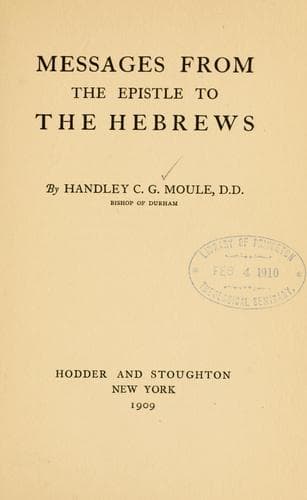
Messages from the Epistle to the HebrewsMoule, H. C. G. (Handley Carr Glyn)
Religion
Messages from the Epistle to the Hebrews
Moule, H. C. G. (Handley Carr Glyn)
Bible. Hebrews -- Commentaries
It is impressive by the majestic singleness of its theme; Faith, from
first to last, is its matter and its burthen. Further, it carries one
long appeal to the heart by its method; almost from the exordium to the
very close it deals with its theme not by abstract reasoning, nor even
by a citation of inspired utterances only. It works out its message by
a display, in long and living procession, of inspired human experiences.
It is to an extraordinary degree human, dealing all along with names as
familiar to us as any in any history can be; with characters which are
perfectly individual; with lives lived in the face of difficulty,
danger, trial, sorrow, as concrete as possible; with deaths met and
overcome under conditions of mystery, suspense, trial to courage and to
trust, which for all time the heart of man can apprehend in their
solemnity. Meanwhile, as a matter of diction and eloquence, the chapter
carries in it that peculiar charm which comes always with a stately
enumeration. It has often been remarked that there is a spell in the
mere recitation of names by a master of verse:
"Lancelot, and Pelleas, and Pellenore."
Or take that great scene in _Marmion_, where the spectral summons is
pealed from Edinburgh Cross:
"Then thunder'd forth a roll of names;
The first was thine, unhappy James!
Then all thy nobles came;
Crawford, Glencairn, Montrose, Argyle,
Ross, Bothwell, Forbes, Lennox, Lyle,
Each chief of birth and fame."
And the consummate prose of this our chapter moves us with the like
rhythmical power upon the spirit, while from Abel and Enoch onwards we
hear recited, name by name, the ancestors of the undying family of
faith. No wonder that the chapter should have inspired to utterances
formed in its own style the Christian eloquence of later days, as in
that noble closing passage of Julius Hare's _Victory of Faith_, where he
carries on the record through the apostolic age, and the early
persecutions, and the times of the Fathers, to Wilfrid and Bernard, the
Waldenses, Wiclif, Luther, Latimer, down to Oberlin, and Simeon, "and
Howard, and Neff, and Henry Martyn."
So we approach the chapter, familiar as it is (and it is so familiar
because it is so great), with a peculiar and reverent expectation. We
look forward to another visit to this great gallery of "the portraits of
the family of God" with a pleasure as natural as it is reverent and
believing. True to our plan in these expositions, however, we shall not
attempt to comment upon it in the least degree fully or in detail. Our
aim will be rather to collect and focus together some main elements of
its teaching, particularly in regard of their applicability to our own
days.
The first question suggested as we read is, what is the connexion of the
chapter? Why does the Writer spend all this wealth of example and
application upon the one word Faith?
Public-domain text, read in full here on John Shaqi.
Reviews
Reviews
No reviews yet
Be the first to share your thoughts on this work.
Join the Discussion
Join the discussion
Sign in to leave a comment or review.
Sign InorCreate an account