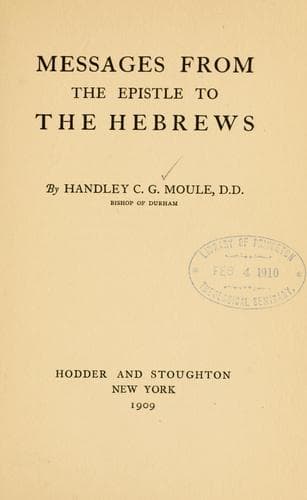
Messages from the Epistle to the Hebrews — John Shaqi
Messages from the Epistle to the HebrewsMoule, H. C. G. (Handley Carr Glyn)
Religion
Messages from the Epistle to the Hebrews
Moule, H. C. G. (Handley Carr Glyn)
Bible. Hebrews -- Commentaries
The reason is not far to seek. The tenth chapter closes with that word,
or rather with that truth: "My righteous man shall live by faith"; "we
are of them that have faith, unto the saving of the soul." And this
close is only the issue of a strain of previous teachings, going far
back towards the opening of the Epistle. "The evil heart of unbelief,"
of "unfaith," if the word may be used, is the theme of warning in iii.
12: "They could not enter in because of unbelief" (iii. 19). "The word
of hearing did not profit them" because of their lack of faith (iv. 2).
It is "we who have believed" who "enter into God's rest" (iv. 3).
Looking to our great High Priest and His finished work, we are to "draw
near with a true heart, in fulness of faith" (x. 22), for the
all-sufficient reason that such trust meets and appropriates eternal
truth: "He is faithful that promised" (x. 23).
These explicit occasional _mentions_ of faith are, however, as we might
expect, only a part of the phenomenon of the great place which _the
idea_ of faith holds in the Epistle. When we come to reflect upon it,
the precise position of the Hebrew Christians was that of men seriously,
even tremendously, tempted to walk by sight, not by faith. The Gospel
called them to venture their all, for time and eternity, upon an
invisible Person, an invisible order, a mediation carried on above the
skies, a presentation of sacrifice made in a temple infinitely other
than that of Mount Moriah, and a kingdom which, as to all outward
appearance, belonged to a future quite isolated from the present. On the
other hand, so they were told by their friends, and so it was perfectly
natural to them to think, the vast visible institutions of the Law were
the very truth of God for their salvation, and those institutions
appealed to them through every sense. Why should they forsake a creed
which unquestionably connected itself with Divine action and revelation
in the past, and which presented itself actually to them under the
embodiment of a widespread but coherent nation, all descended from
Abraham and Israel, and of a glorious "city of solemnities," and of a
temple which was itself a wonder of the world, and of which every detail
was "according to a pattern" of Divine purpose, and in which all the
worship, all the ritual, done at the altars and within the veil, was
great with the majesty of Divine prescription? There the pious Israelite
could behold one vast sacramental symbol of JEHOVAH'S life, glory, and
faithfulness. And the living priesthood that ministered there, in all
its courses and orders, was one large, accessible organ of personal
witness to the blessings assured to the faithful "child of the Law."
Public-domain text, read in full here on John Shaqi.
Reviews
Reviews
No reviews yet
Be the first to share your thoughts on this work.
Join the Discussion
Join the discussion
Sign in to leave a comment or review.
Sign InorCreate an account