Messages from the Epistle to the Hebrews — John Shaqi
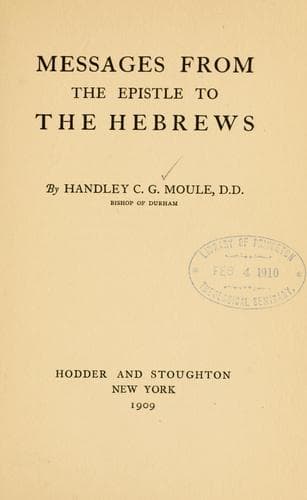
Messages from the Epistle to the HebrewsMoule, H. C. G. (Handley Carr Glyn)
Religion
Messages from the Epistle to the Hebrews
Moule, H. C. G. (Handley Carr Glyn)
Bible. Hebrews -- Commentaries
What is a definition? A precise and exclusive statement of the
essentials of a thing, such that it will fit no other thing. A
description may be something altogether different from this. It may so
handle the object that the terms are not exclusive at all, but are
equally applicable to something else; as here for example, where the
phraseology would equally well describe imagination in its more vivid
forms--a thing as different as possible from faith. To be quite
practical, we have here, if we read this first verse in the light of
the whole subsequent development of the chapter, a description of faith
at work, of the potency and victories of faith, rather than a definition
of faith in its distinctive essence. A true parallel to this passage is
the familiar sentence, "Knowledge is power." Those words do not define
knowledge, obviously; to do that would demand a totally different
phrase. What the words do is to give us one great resultant of
knowledge; to tell us that the possession and use of knowledge endows
the man who knows with a force and efficiency which he would lack
without it. Few words are more elastic and adaptable than the verb
substantive. "_Is_" can denote a wide variety of ideas, from that of
personal identity, as when I see that yonder distant figure _is_ my
brother; to that of equivalence, as when a stamped and signed piece of
thin paper called a bank-note _is_ five pounds of gold; or to that of
mere representation, as when another piece of paper, or a sheet of
canvas, duly lined and coloured by the artist to show the semblance of a
human face, _is_ the King, or _is_ my father; or to that of result and
effect, as when we say that knowledge _is_ power, or that seeing _is_
believing.[M]
[M] It is obvious that these elementary reflections have everything to
do with the need of caution in explaining those most sacred words, "This
_is_ my body which is given for you."
Here we have precisely that last application of the verb substantive,
only in an exact and most noble antithesis. "Seeing is believing," says
the familiar proverb. "Believing is seeing," says the Divine word here.
That is to say, when the human soul so relies upon God that His word is
absolute and sufficient for its certainties, this reliance, this faith,
has in it the potency of sight. It is as sure of the promised blessing
as if it were a present possession. It is as ready to act upon "the
things not seen as yet," the laws, powers, hopes beyond the veil, as if
all was in open view to the eyes of the body.
Public-domain text, read in full here on John Shaqi.
Reviews
Reviews
No reviews yet
Be the first to share your thoughts on this work.
Join the Discussion
Join the discussion
Sign in to leave a comment or review.
Sign InorCreate an account