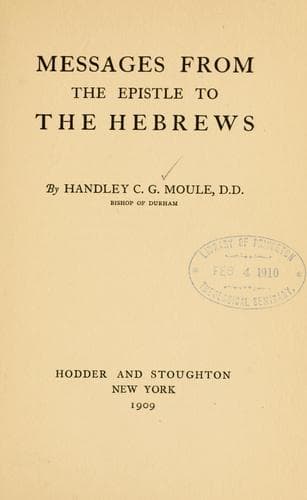
Messages from the Epistle to the HebrewsMoule, H. C. G. (Handley Carr Glyn)
Religion
Messages from the Epistle to the Hebrews
Moule, H. C. G. (Handley Carr Glyn)
Bible. Hebrews -- Commentaries
Christian periods, accordingly, for the least perilous and heroic forms
of faithful Christian service, it is vital to remember that attitude and
action of the soul which we call faith. For faith is essential both to
the victories and the utilities of the Christian life, just so far as
that life touches always at its living spring "things hoped for,"
"things not seen." And at a time like that of the first readers of the
Epistle every such necessity was enhanced indefinitely, both by the
perils and threatenings which they had to face and by the majestic
illusion to which they were continually exposed--the illusion under
which the order of the Law, because it was Divine in origin and
magnificent in its visible embodiment, looked as if it must be the
permanent, the final, phase of sacred truth and life on earth.
In our next chapter we will consider both the account of faith here
given and some main points in the illustration of it by examples.
CHAPTER IX
FAITH AND ITS ANNALS
HEB. xi. (II.)
We considered in the last chapter the account of Faith with which the
apostolic Writer opens this great recital of the "life, work, and
triumph of faith" in holy human lives. His words, as we found, lend
themselves to some variety of explanation in detail: the term [Greek:
hypostasis] alone may be interpreted in at least three ways. But I do
not think that this need disturb us as to the essential meaning of the
description. Each and all of the renderings leave us with the thought
that faith has a power in it to make the thing hoped-for act upon us as
if it were attained, and the invisible as if it were before our eyes.
We may pause so far further over the description of faith here as to
point out that it is precisely this, a description, not a definition. To
quote Heb. xi. 1 as a good definition of faith is to mistake its import
altogether. I have often recalled, in speech or writing, a story told
me forty years ago by an Oxford friend when we were masters together at
a public school. He had attended a Greek Testament lecture at his
college a few years before, and the lecturer one day asked the class for
a definition of faith. Some one quoted Heb. xi. 1, and the lecturer's
answer was, "You could not have given a worse definition." My old
friend, a "broad" but most reverent Churchman, referred to this as an
instance of painful flippancy. It may have been so. But I am prepared to
think that the lecturer may not have meant it so at all. He may only
have expressed rather crudely his view, the right view, to my mind, that
we have here not a definition of faith at all but a description of faith
as an operative force, an account of what faith looks like when it is at
work; and this is a very different matter.
Public-domain text, read in full here on John Shaqi.
Reviews
Reviews
No reviews yet
Be the first to share your thoughts on this work.
Join the Discussion
Join the discussion
Sign in to leave a comment or review.
Sign InorCreate an account