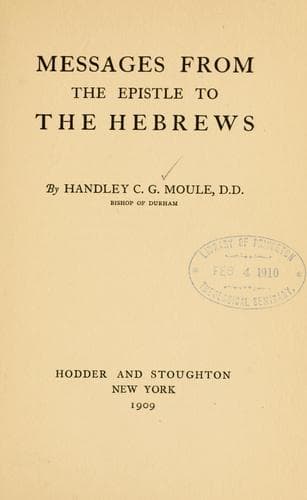
Messages from the Epistle to the HebrewsMoule, H. C. G. (Handley Carr Glyn)
Religion
Messages from the Epistle to the Hebrews
Moule, H. C. G. (Handley Carr Glyn)
Bible. Hebrews -- Commentaries
One partial exception, and only one, to this great ruling lesson of the
chapter is to be noted; it occurs in the second verse. There "by faith
we perceive that the worlds," the _aeons_, the dispensations and
evolutions of created being, "have been framed," perfected, adjusted to
one another, "by the Word of God, so that not from things which appear
has that which is seen originated." These words appear to be inserted
where they stand in order, so to speak, to carry the sequence of the
references to the Old Testament down from its very first page. The work
of faith has exercise in face of the mysterious narrative of Creation,
and in this one instance the exercise is quoted as what concerns us now
quite as much as "the elders." They like us, we like them, get our
guarantee as to the facts of the primal past not by sight but by faith,
by taking God at His word. He, in His revelation, tells us that "in the
beginning"--the beginning of whatever existence is other than
eternal--"God created." Things finite, things visible, came into
original being not as evolved from previous similar material, but as of
His will.
But when that pregnant side-word has once been said, the argument
settles itself forthwith upon the recorded examples of the potency of
faith as "the elders" exercised it. We see man after man enabled to
treat the invisible as visible, the promised as present, by reliant rest
upon the word of God, however conveyed. To Abel, we know not how, it was
divinely said that the sacrificed "firstling" was the acceptable
offering, and, antecedent to any possible experience, he offered it. To
Enoch, we know not how, it was made known that the Eternal, as invisible
to him as to us, cared for man's worshipping company, and he addressed
himself through his age-long life to "walk with God." Noah was apprised,
for the first time in man's known history, of an approaching cataclysm
and of the way of escape; the promise came to him wrapped in the cloud
of an awful warning, and it was long delayed, but he acted upon it in
the steady energy of faith. Abraham was "called," we know not precisely
how, but in some way which tested his reliance on things "not seen as
yet," and he set out on that wonderful life of a hundred years of faith.
He renounced the settled habits and old civilization of Chaldea for the
new life of a Syrian nomad, "settling permanently in tents" ([Greek: en
skenais katoikesas]), he and his son and his grandson after him, all in
view of an invisible future made visible by the trusted promise, a
future culminating at last to his "eye of faith," so here we are
solemnly assured, in the city of the saints, in the Canaan of the
heavens. The same reliance on the sheer word of promise nerved him to
the awful ordeal of the all-but immolation of his son. And that son in
his turn, against all appearances, and rather bowing to the Word of God
than embracing it, blessed _his_ least-loved son above his dearest; and
Public-domain text, read in full here on John Shaqi.
Reviews
Reviews
No reviews yet
Be the first to share your thoughts on this work.
Join the Discussion
Join the discussion
Sign in to leave a comment or review.
Sign InorCreate an account