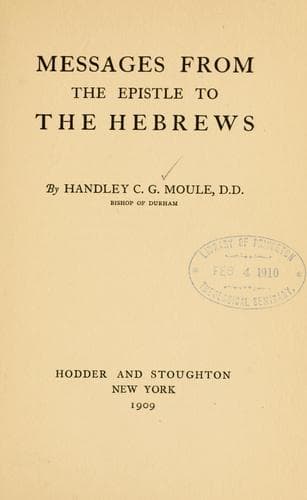
Messages from the Epistle to the HebrewsMoule, H. C. G. (Handley Carr Glyn)
Religion
Messages from the Epistle to the Hebrews
Moule, H. C. G. (Handley Carr Glyn)
Bible. Hebrews -- Commentaries
that son in his turn, and his son in his turn, carried the process on,
treating the greatness of Ephraim and the deliverance from Egypt as
things seen and present, because God had so spoken. The parents of
Moses, and then Moses himself, in his strange life of disappointments
and wonders, deal likewise with the future, the unseen, the seemingly
impossible, on the warrant of a promise. Figures as little heroic in
natural character as Sarah, as little noble in life as Rahab, take place
in the long procession, as those who treat the invisible as visible by
faith. So do the thronging "elders" of ver. 32--a group singularly
diverse in everything but this victory over the seen and present by
faith in the promise. So do the unnamed confessors and martyrs of the
closing paragraph, the heartbroken, the tortured, the wanderers of the
dens and caves, who all alike, amidst a thousand differences of
condition and of character, "obtained a good report through faith"; and
all won through faith that victory, so great when we reflect upon
it--that they died "not having received the promise." They trusted _to
the very end_. When they sank down in death upon their shadowy path of
pilgrimage, "the promise," the promised Christ, had not yet come.
Nevertheless they treated the hope of Him as fact, and they won their
victory by faith.
And now they are parts and members of the "great cloud" who watch us in
our turn--us, with things unseen and hoped-for still in front, but with
JESUS at our side.
CHAPTER X
FOLLOWERS OF THEM
HEB. xii. 1-14
The Epistle approaches its close. The Writer has much yet to say to the
disciples upon many things, all connected with that main interest of
their lives, a resolute fidelity to the Lord, to the Gospel, and to one
another. But he has not yet quite done with that side of their
"exceeding need" to which the antidote is _the faith_ which can deal
with the future as the present, with the unseen as the seen. Upon this
theme, from one aspect or another, is spent the passage now before us.
Public-domain text, read in full here on John Shaqi.
Reviews
Reviews
No reviews yet
Be the first to share your thoughts on this work.
Join the Discussion
Join the discussion
Sign in to leave a comment or review.
Sign InorCreate an account