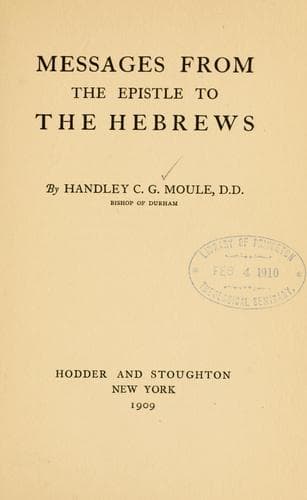
Messages from the Epistle to the Hebrews — John Shaqi
Messages from the Epistle to the HebrewsMoule, H. C. G. (Handley Carr Glyn)
Religion
Messages from the Epistle to the Hebrews
Moule, H. C. G. (Handley Carr Glyn)
Bible. Hebrews -- Commentaries
But the holy Writer has more to say yet about the motives to faith. He
points the weary saints upward, even beyond the "cloud," to a Form
radiant and supreme. They are to run, conscious of the witnesses, but
yet more intently "looking off ([Greek: aphorontes]) unto JESUS, the
supreme Leader ([Greek: archegon]) and Perfecter of faith"; that is to
say, the Lord of the whole host of the believing, and Himself the
consummate Worker in the field of faith, who, for a joy promised _but
not seen_, "endured the Cross," when its immediate aspect was an
inexpressible outrage and disgrace; reaching the throne of all
existence, as Son of Man, in spite of every possible appearance to the
contrary (ver. 2). Yes, and not only was that final victory thus won by
Him, but He arrived at it by a path full of the conflicts which threaten
faith. He "endured the contradiction of sinners against Himself" (ver.
3). Year by year, day by day, from the Pharisee, from the worldling,
from the leaders of religion, from the inconstant crowd, He had
"contradiction" to endure--sometimes even from "the men of His own
household." He was challenged to prove His claims; He was insulted over
His assertion of them, or over His silence about them. In every way, at
every turn, they spoke against Him to His face, as He slowly advanced,
through a life of love and suffering, to the Agony and the Crucifixion.
Let us not think that all this put no strain, even in the King Messiah,
upon faith. It may seem scarcely reverent (I know devout and thoughtful
Christians who have felt it to be so) to speak of our blessed Lord as
exercising faith, as being the supreme Believer. But we need not shrink
from the thought. It is no more irreverent, surely, than to accept the
evidence of the Gospels to His perfect human capacity to be weary, to be
surprised, to be specially moved to compassion by _the sight_ of
suffering. In His sinless conformity "in all things to His brethren"
there was never for one moment room in Him--of this we may be amply
sure--for error of thought or of word, as He acted as the supreme and
absolute Prophet of His Church. But there was room, so we are expressly
told, on one tremendous occasion at least (Matt. xxvi. 37), for a
mysterious "bewilderment" ([Greek: ademonein]) of His blessed human
soul. Can we doubt that the victory won in the Garden, after which He
went with profound calmness to the unjust priest, and Pilate, and the
Cross, was of the nature of a victory of faith? Did He not then treat
the coming "joy" as a reality although, in so awful a sense and measure
He did not "feel" it then? The "bewilderment" did not drive Him back
from our redemption; and why? Because "He TRUSTED in GOD that He would
deliver Him" (Ps. xxii. 9; Matt. xxvii. 42), whatever should be the
contents of "the cup" from which His whole humanity turned away as
_almost_ impossible to drink.
Public-domain text, read in full here on John Shaqi.
Reviews
Reviews
No reviews yet
Be the first to share your thoughts on this work.
Join the Discussion
Join the discussion
Sign in to leave a comment or review.
Sign InorCreate an account