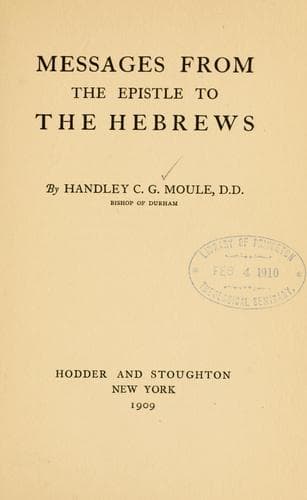
Messages from the Epistle to the HebrewsMoule, H. C. G. (Handley Carr Glyn)
Religion
Messages from the Epistle to the Hebrews
Moule, H. C. G. (Handley Carr Glyn)
Bible. Hebrews -- Commentaries
And may we not be sure that on many a previous occasion of minor and yet
bitter trial, when evil men gathered round Him with cynical objections
and ruthless denials of His claims, the victory was akin to the victory
of Gethsemane? Often, surely, a strange "bewilderment" must have beset
the Redeemer's soul, of which the external token was the sigh, the
groan, the tears, which shewed Him to be so truly Man.
We all hold, in full doctrinal orthodoxy, that the Lord's sufferings,
both of soul and body, were no "docetic" semblance but a deep and
infinitely pathetic reality. But we need at times to think somewhat
deliberately in order to receive the full impression of that truth upon
the heart. And then surely we are constrained to see in Him, who thus
really suffered and really "endured," the supreme Exemplar of the
victory of faith, the perfect Sympathizer with the tried believer.
From this pregnant thought, of the faith exercised by JESUS, the
disciple is directly led in the remainder of our passage to the
practical inferences for himself. The days, for those first readers of
the Epistle, were indeed evil. Though not yet called to martyrdom (ver.
4), they were hard beset, not only by importunate reasonings and appeals
which, as we have seen all along, were straining their spiritual
allegiance, but by actual outrages (see _e.g._ x. 34), by the
"scourging" (ver. 6) of bitter social persecution. Well, "looking off
unto" Him who had so greatly endured, they were, in these things also,
to see the unseen and to presentiate the future. From the Proverbs (iii.
11, 12), that book where the apostolic insight so often finds the purest
spiritual messages,[O] he quotes (verses 5, 6) the tender words which
bid the chastened child see in his chastening the assurance (ver. 8) of
his happy, holy sonship in the home of a Father, "the Father of our
spirits," who, unlike our earthly fathers even at their best (and that
was a noble best indeed), not only chastens, but chastens with an
unerring result of holiness in the submissive child--yea, a holiness
which is one with His own (ver. 10), His Spirit in our wills.
[O] It was evidently a book dear to St. Peter's mind, as his First
Epistle shews.
Public-domain text, read in full here on John Shaqi.
Messages from the Epistle to the Hebrews — John Shaqi
Reviews
Reviews
No reviews yet
Be the first to share your thoughts on this work.
Join the Discussion
Join the discussion
Sign in to leave a comment or review.
Sign InorCreate an account