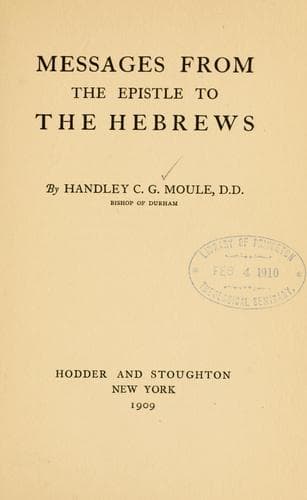
Messages from the Epistle to the HebrewsMoule, H. C. G. (Handley Carr Glyn)
Religion
Messages from the Epistle to the Hebrews
Moule, H. C. G. (Handley Carr Glyn)
Bible. Hebrews -- Commentaries
Isaac knew that he had but carried out, blind as he was, the will of
God.
Then follows (verses 18-24) that sublime antithesis of Sinai and Sion
which forms one of the greatest examples of rhythmical, of almost
lyrical, eloquence in the whole New Testament. On the one hand looms on
the view the Thing,[P] material, tangible ([Greek: pselaphomeno]), all
on fire, black with tempestuous cloud, its echoes pealing (ver. 19) to a
tremendous trumpet-blast and then to a yet more awful "voice of words."
At its base cowers an awe-struck, horror-struck, host of men,
shuddering at the warning (ver. 20) not to touch the fatal rocks,
crowding for refuge round a leader who himself owns (ver. 21) to
heart-shaking fears.[Q] On the other hand, as the eyes of faith are
lifted, there shines into view, and in the closest spiritual proximity
(for the believing company has actually "come unto it," ver. 22), the
hill eternal, the true Mount Sion, where shines the city of the living
God, the Jerusalem of heaven. No barren rocks are there, nor do menaces
of articulate thunder sound from and around that height. All is light,
and all is life. Yes, above all things all is life. Behold the countless
thousands ([Greek: myriasin]) of radiant denizens, the angelic friends
of man; and then beatified men besides (ver. 23), "festal, assembly and
church of the first-born, enrolled in heaven"; the Blessed gone before,
the "great cloud," seen now in their other character, as the triumphant
throng of a celestial Passover, or of a Tabernacle-feast of palms, kept
in the better Canaan to commemorate the mercies of the mortal
wilderness. And there, centre and sun of the wonderful scene, is the
glory of the "Judge of all," Vindicator (so we read the meaning of the
word [Greek: krites] here) of His afflicted ones, treading down their
enemies and presiding in majesty over their happy estate. Around Him
rest and rejoice the pure "spirits of the just made perfect," the dear
and holy who have lately passed through death, "perfected" already, even
before their resurrection, in respect of the course finished, the fight
fought, the faith kept, the trial for ever over. Lastly (ver. 24), the
form is seen of the more than Moses of this better Mount of God. Behold
the Mediator, not of the old covenant but of the new, the Covenant of
the Eternal Spirit. Behold the Surety of the promise of the purified
heart, the promise sealed with that sprinkled blood of the Incarnate
Lamb which, in Divine antithesis to the call for vengeance on the
fratricide which went up from Abel's death, claims for the "brethren"
who once slew their Deliverer not remission only but holiness and
heaven.
[P] The word [Greek: orei] is certainly absent from the true text. We
are left as in presence of a mysterious _somewhat_, a mighty mass,
mantled in terror and without form or name.
[Q] A traditional utterance must be referred to. But the whole narrative
in Exodus and in Deuteronomy supports it.
Public-domain text, read in full here on John Shaqi.
Reviews
Reviews
No reviews yet
Be the first to share your thoughts on this work.
Join the Discussion
Join the discussion
Sign in to leave a comment or review.
Sign InorCreate an account